Mazda blind spot monitoring system takes the blame for a Pennsylvania motorcycle crash
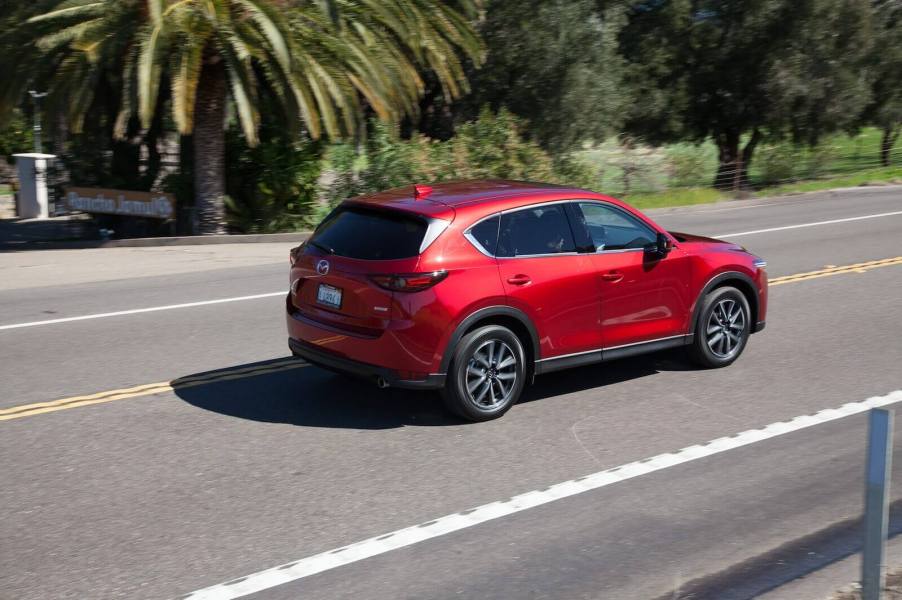
“Look twice for motorcyclists.” You’ve likely seen that catchy reminder on road signs, digital displays, and even bumper stickers. Quite simply, that’s because motorcycles are trickier to spot than other, larger vehicles. As a result, drivers like this one in a Mazda CX-5 simply run into them while turning, changing lanes, or pulling out.
But in this case, a lawsuit alleges that the Mazda driver isn’t the only one to blame. Instead, the plaintiff’s legal representation says the CX-5’s blind spot monitoring feature failed to alert the driver.
A lawsuit alleges that a Mazda driver and the CX-5’s blind spot monitoring system are to blame for causing a motorcycle crash
A Pennsylvania motorist was driving his 2017 Mazda CX-5 in the passing lane of northbound Interstate 79. He decided to change lanes, pushing right into the next lane. Unfortunately, the coast was far from clear.
At that same moment, a 2012 Harley-Davidson Electra Glide, a larger bagger motorcycle, was cruising in the right lane. The CX-5 occupied the same space as the Harley-Davidson, hitting it and causing it to crash.
Enter the lawsuit. It alleges that, while the driver is responsible for checking their mirrors and clearing their path, the Mazda CX-5’s factory blind spot monitoring suite failed to alert the driver that “there was a motor vehicle already present in the left-hand lane of I-79,” per Car Complaints.
According to the lawsuit, Mazda’s product was “defectively designed and manufactured because it lacked necessary technologically feasible safety systems.” Strong claims, but ultimately, the responsibility of making sure the path is clear rests with the driver, not the blind spot monitoring system.
The automaker says the technology is no substitute for failing to check your surroundings
Mazda also asserts that the blind spot monitoring functions on its vehicles serve as driver assistance features. It’s not, however, an all-encompassing self-driving solution to these sorts of crashes. “The system is only designed to assist you in checking for vehicles at your rear when making a lane change,” the CX-5’s manual reads.
“Due to certain limitations with the operation of this system, the Blind Spot Monitoring (BSM) warning indicator light, the warning sound, and the warning screen indicator display may not activate or they might be delayed even though a vehicle is in an adjacent driving lane,” it added. “Always make it your responsibility as a driver to check the rear.”