AI is making the Ducati Lenovo MotoGP team faster one lap at a time
Last weekend, Marc Márquez of Ducati Lenovo took the checkered flag in Qatar. Weeks ago, Francesco “Pecco” Bagnaia did the same, snagging a brilliant win under a big Texas sky at the Grand Prix of the Americas. That doesn’t just happen. Predictive AI and Ducati Lenovo’s “Remote Garage” harnesses the power of data to keep the MotoGP team’s riders on the ragged edge of possibility and firmly on the podium.
50 sensors gather a tidal wave of data, giving the Ducati Lenovo MotoGP team the equivalent of a 300-meter head start every race
I recently picked up my first personal Ducati, a relatively-babied Monster 821 in an eye-catching red. Inconspicuous? Not so much. But it’s a far cry from the Desmosedici GP25 that carried Ducati Lenovo MotoGP riders Marc Márquez and Francesco Bagnaia to the only four wins of the 2025 racing season thus far.
No, nothing like the featherweight blends of carbon fiber, aluminum, and titanium sitting in the Ducati Lenovo pit garages at COTA. But it did excite me that much more to get a behind-the-scenes look at how Ducati Corse maintains such a commanding dominance in the sport. It’s not just the wicked talent of Pecco and Márquez– although that doesn’t hurt.

Each Desmosedici GP25 collects data with 50 sensors every time it hits the track. COTA to Qatar, Japan to Spain. The little detectors collect information about air pressure, oil levels, suspension characteristics, and so much more. Hell, Ducati Corse Electronics Systems Manager Gabriele Conti says that around 60% of the data-gathering and analysis is focused on tire performance and wear alone.
Altogether, the data helps Ducati Lenovo evaluate limitations. More importantly, it helps Ducati’s MotoGP team get Márquez and Pecco as close to the limit as possible without crashing. That’s an important qualifier, there. After all, one of the old-school means of finding the limit was to, well, crash.
Whenever one of the sensor-equipped Desmosedici GP25s returns to the pit garage, the first thing the crew does is plug the beast in and download its invaluable racing intel. It’s so much data, really, that Lenovo and Ducati set up a remote analysis hub in the company’s Bologna headquarters to synthesize the information into the means to make the Ducati racing motorcycles that much quicker.

Even a crash can teach a valuable lesson with Ducati Lenovo ‘Remote Garage’
In 2020, Lenovo and Ducati teamed up to introduce the “Remote Garage,” a specialized part of Ducati’s headquarters in Bologna, Italy. The data hub uses predictive AI, Lenovo Edge computing servers, and High-Performance Computing (HPC) Solutions to analyze racing data all day, every day.
In addition to collecting information about the limitations of tires, bikes, conditions, and riders, the Remote Garage pores over racing data to allow the team to make changes and highlight areas for improvement before the starting lights go out on race day at MotoGP. Even when that data is related to a crash.

I was excited to see Márquez and Pecco take on COTA’s near-blind first corner approach for the first time since watching Márquez practice on the same circuit years earlier. But no sooner had I reached the safety lane beneath the 22-story COTA Tower than Márquez had a crash. The yellow flags came out, and Márquez’s motorcycle went in.
Ducati Corse’s Yuri De Cassan was there to talk to me after the spill. The wounded bike was out of view, stripped apart for repair. Yuri expressed that this was a full-team effort. The engineers in Bologna would work through the data gathered from the plugged-in motorcycle. And the red shirts in Austin would work diligently to keep the MotoGP team moving. “Unlucky,” Yuri said. “Today, they don’t get lunch,” he joked, referring to the working, albeit relaxed, atmosphere in the pit.
The data to make decisions in changing conditions
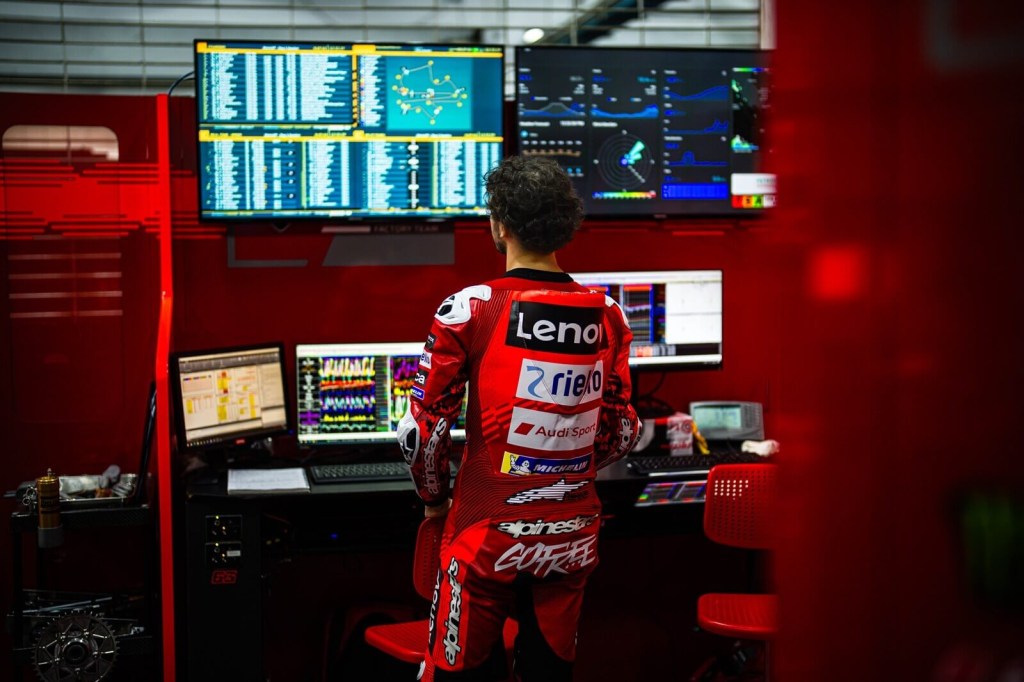
In all seriousness, even the temperamental weather of Central Texas isn’t too much for the Remote Garage. At COTA, for example, changing conditions presented different data sets about important factors like traction limitations. With the sensors constantly collecting data and the MotoGP team sending information to Remote Garage, the Ducati Corse team can make adjustments immediately. Gone are the days of waiting for useful data until after a race weekend.
Of course, there are limits. At the core of things, predictive AI can’t pilot the bikes. No, Ducati Corse still needs world-class talent like Pecco and Márquez to monopolize the podium every race weekend. Also, Ducati and Lenovo’s partnership must be above board. The use of the technology is bound by regulations, just like any other component on the motorcycle. That said, you can’t argue with results, and Ducati Corse’s season so far is a testament to technology’s place in MotoGP.