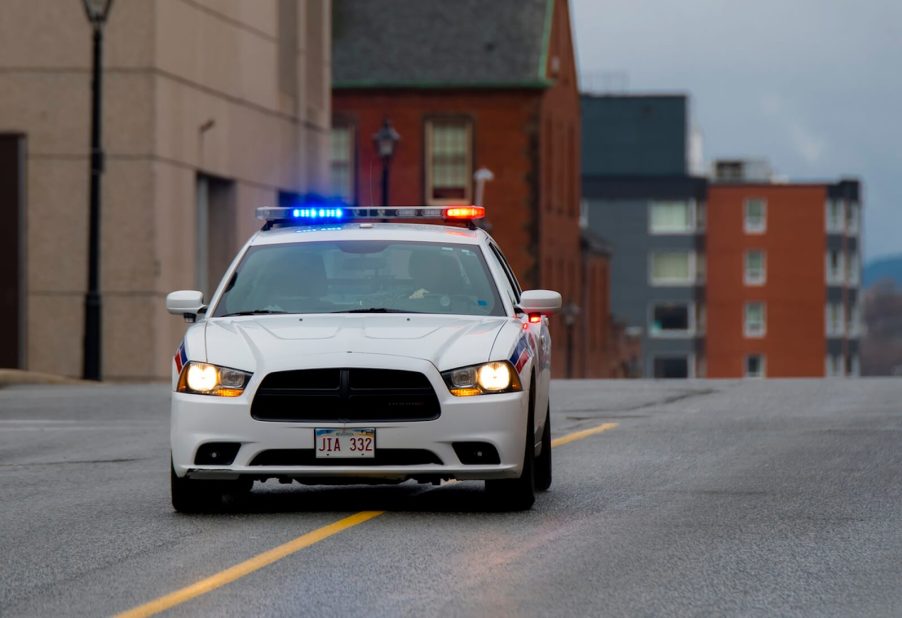
Why do police officers give up on high-speed chases?
A “failure to stop” is a big deal for law enforcement officers (LEOs). Depending on the jurisdiction, the type of fleeing vehicle, and the specific situation, someone refusing to stop for a police officer with lights and sirens often leads to pursuits or high-speed chases. Periodically, however, police officers will give up their pursuit in favor of other tactics. So, just when do cops decide to call it quits in a high-speed chase?
A police officer may terminate a high-speed chase or pursuit for multiple reasons from safety to policy
Sure, they’re exciting. I mean, who doesn’t think back to news helicopter footage of a screaming Dodge Challenger SRT Hellcat or O.J. Simpson leading police units in a pursuit? Okay, so the latter doesn’t quite qualify as a high-speed chase. That “O.J.-era” Ford Bronco, as a friend of mine calls it, wasn’t going anywhere quickly. However, there are reasons why police officers would call off a pursuit.
- If an officer is instructed by a supervisor to call off a pursuit
- The fleeing vehicle is too fast for police vehicles to conceivably chase
- Officers abide by a “no-chase rule”
- A pursuing unit is damaged and cannot safely continue a pursuit
- A fleeing vehicle’s location is unknown to pursuing units
According to the UCLA Police Department, one of the reasons a police officer will terminate a vehicle pursuit is if they’re “directed by a supervisor.” Sure, UCLA’s department probably doesn’t engage in many high-speed pursuits. However, the impetus is sensible. After all, wouldn’t you want a so-called hothead to back off if the department considers a chase unsafe?
One of the reasons for a supervisor’s termination might be due to safety concerns. It’s an obvious decision in some cases. For instance, a couple of years ago, Mohamed Ahmed Abu-Shlieba tried to give Houston-area police the slip in an early-model Dodge Challenger SRT Hellcat. In that “high-speed pursuit,” the Hellcat left pursuit units in the dust as it approached its 199-mph top speed. However, police caught up with the Mopar muscle car after it swilled the contents of its gas tank.
In that same vein, some departments may operate with a “no-chase rule.” In this context, officers may avoid engaging in high-speed chases with speeding motorcycles and cars for safety concerns. Furthermore, if a chase damages a law enforcement officer’s vehicle, they may discontinue their participation in a chase.
Beyond safety considerations, should a fleeing vehicle manage to evade police units, the department may discontinue a pursuit. However, the police will likely use descriptions, perimeter searches, and “be-on-the-lookout” (BOLO) communications to keep looking for offenders. Sorry kids, the Grand Theft Auto (GTA) franchise is a game– not reality.