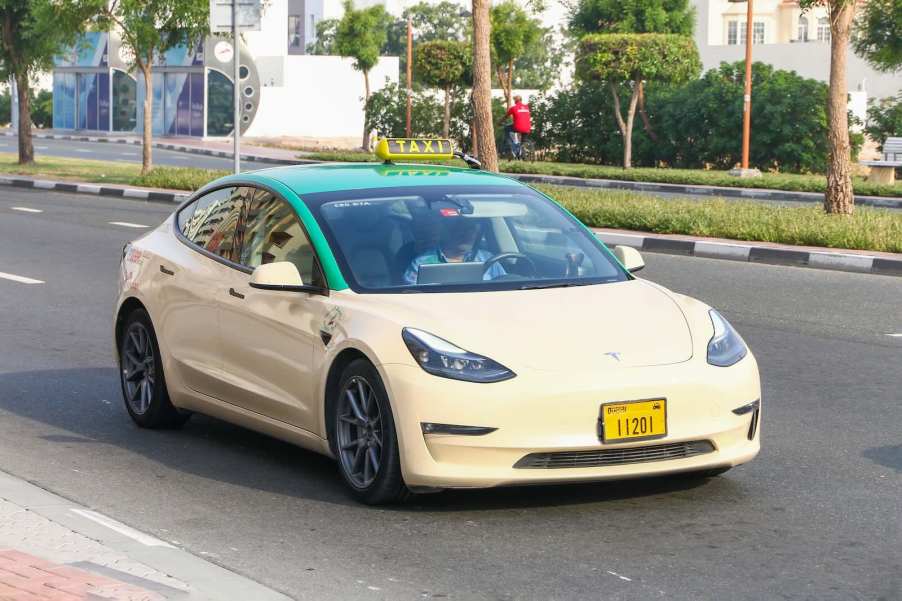
Here’s how a Tesla Model 3 taxi’s battery held up after 255,000 miles
One hesitation drivers have about EVs is how fast their batteries degrade. Until the first generation of EVs reaches ultra-high mileage, we have very little real-world data. But one mechanic just posted about a Model 3 that’s held up heroically, and it might have to do with how the EV was charged.
A mechanic in Port Kennedy, Australia, posted about the long-lived Model 3 on the EV Workz Facebook forum for mechanics. “This is the highest mileage Tesla I have personally seen and had the privilege to work on.”
The EV in question was a Tesla Model 3. The Uber-driving owner complained it was shuddering under heavy acceleration. With 255,000 miles on the clock, the mechanic worried it would need serious powertrain work. But not so much. It needed motor mounts. Because electric drive units are a fraction of the size of a traditional engine, this wasn’t an involved job. Then the mechanic checked the battery health. The battery had 88% to 90% of its original capacity left.
That’s right. In 250,000 miles that would have decimated the powertrain of many ICE vehicles, the EV had barely touched its battery capacity.
The secret to this Tesla Model 3’s long-lived battery pack
A quick calculation shows that if a Tesla Model 3 Long Range loses 15% of its battery capacity by 300,000 miles, its total range would drop from 363 miles to a very usable 255 miles. A commuter without need of a longer-range road trip car could continue using a 200-mile Tesla for hundreds of thousands of miles with relatively minor maintenance.
The mechanic pointed out that of the 49,928 kWh that had gone through the Tesla’s battery, just 15,556 kWh was added via DC fast charging. The majority, 38,012 kWh (71%), came in through an AC charger, such as a slower overnight charger. Outlets such as InsideEVs have theorized that might be key to its battery holding up so well. But batteries lasting this long may prove to be the norm, not the exception.
Most EV drivers with a home charger will do 70% of their charging—or more—on an AC charger. But that’s not all.
Tesla guarantees its LFP batteries for 1,500 cycles before they drop to 85% of their original charging capacity. During average driving, that will likely equal 300,000 miles.
So in our electric future, will cars such as this Model 3 duck into the shop at 250,000 for a minor job—such as motor mounts—and then turn right around and go back to work? We’ll have to wait to know for sure, but it’s a distinct possibility.