5 car-centered American factories canceled in 2025, and 3 still on track
While the U.S. manufacturing sector continues to wrestle with shifting federal policies and economic headwinds, at least five major car-related facilities have been canceled or paused, according to various company statements and third-party tracking. Meanwhile, three high-profile plants, including EV-focused factories, are still forging ahead, even as the landscape changes.
The shake-up largely follows the Trump administration’s move to pause clean energy grants and reorient industrial strategy toward fossil fuels and nuclear energy
This policy shift undercut momentum built under the Inflation Reduction Act and forced several EV and battery projects into chaotic limbo. Environmental group E2 reports that by May, $15.5 billion in clean energy projects had been canceled in 2025, costing the U.S. about 12,000 potential jobs.
Cancellations and delays mount
Among the most notable setbacks Manufacturing Dive shared is Intel’s Ohio One semiconductor campus. Though not an automaker, Intel plays a key role in supplying chips that power everything from EVs to infotainment systems. The company delayed the completion of its $28 billion site from 2026 to 2030 and 2031. It had previously secured $1.5 billion in federal funding under the CHIPS Act.
AESC, a battery cell maker, paused its $1.6 billion South Carolina project. While the company insists the plan isn’t dead, it gave no new timeline.
Bosch also hit the brakes on its $200 million hydrogen fuel cell factory in the same state. The facility would have built fuel cells for Class 8 trucks, a vital piece of future zero-emission freight plans.
Freyr Battery, now rebranded as T1 Energy, outright canceled a $2.5 billion Georgia battery plant and pivoted to solar after acquiring another company’s facility. The shift cost the state 700 promised jobs, though T1 claims its solar plans will eventually create 1,800.
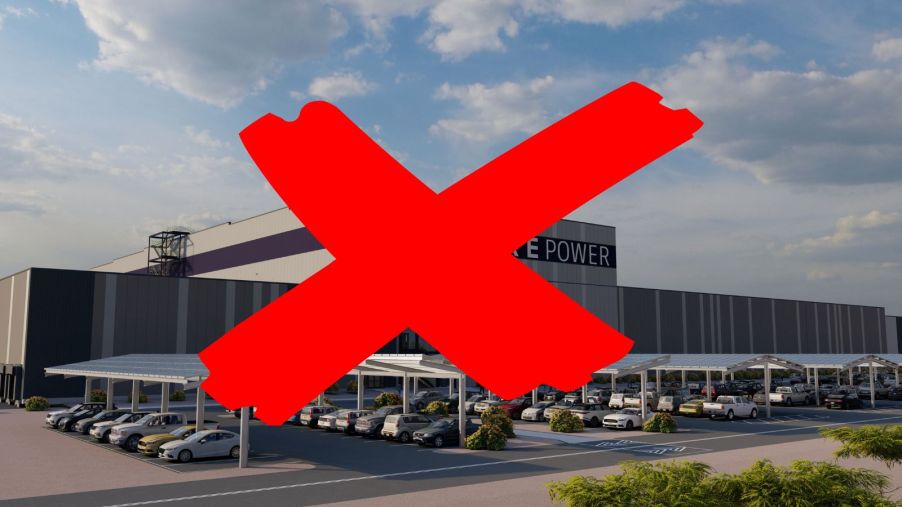
Kore Power walked away from a $1.2 billion Arizona battery plant. Not only did the project die quietly, but the site was listed for sale, and the CEO stepped down.
Other clean energy-related cancellations and slowdowns include more than a dozen smaller operations that hadn’t yet broken ground or lost funding momentum after federal policy changes.
But not every factory plan is sitting idle.
Still building…and betting on the future
Hyundai delivered one of the year’s biggest wins by opening its Metaplant America facility in Georgia this March. The EV and hybrid plant represents part of a $12.6 billion commitment, with the company planning another $21 billion in U.S. investments through 2028. Hyundai expects the site to produce 500,000 vehicles per year and generate 8,500 jobs by the end of the decade.
Ford and SK On continue building their massive BlueOval SK battery complexes in Kentucky and Tennessee. With $11 billion in total investment and a $9.6 billion federal loan, these sites are expected to kick off production later this year.
JetZero, an aerospace company aiming to reimagine fuel-efficient aircraft, announced a $4.7 billion plant in North Carolina. Construction will start in 2026, with aircraft expected before 2030. Though not an automaker, JetZero’s project reflects a continued appetite for large-scale clean transportation manufacturing. (Okay, you got me…this one’s not automotive, but relevant.)
In any case, even in a turbulent climate, some companies are betting long. The current may look stilled in many areas, but at least part of the industry’s foot is still hovering over the accelerator.