9 Things About Ford That Sound Made Up But Are Totally True
Ford Motor Company’s past is full of decisions, experiments, and milestones. Some that actually feel like tall tales…until you dig into the records. These moments reshaped American manufacturing. Others were small detours that never made it past the prototype phase. But all of them happened.
Here are 9 things about Ford Motor Company that sound made up, but aren’t.
The Model T wasn’t the first car, just the first for the masses
Cars existed for decades before Ford entered the picture. What made the 1908 Model T pivotal was its price and availability.
The company’s expanding plants and evolving production methods allowed everyday workers to buy a car that handled rough, early-20th-century roads and made basic maintenance simple.
Ford didn’t invent the assembly line
Henry Ford receives most of the credit for the assembly line. But Ransom E. Olds used a progressive production line to build the Oldsmobile Curved Dash in 1901.
Olds’ system increased output so dramatically that Ford’s engineers studied it and later developed the continuously moving line that debuted in 1913. That upgrade made the Model T affordable and scaled Ford into a household name.
The famous “$5 Workday” made onlookers think Henry’d lost his mind
When Ford raised wages to $5 a day in 1914, many employers claimed he’d gone nuts. But it proved a solid strategy.
Internally, the move stabilized a workforce that was burning out fast on repetitive assembly tasks. Retention soared, and productivity followed.
Factory workers once pulled chassis across the floor with ropes
Before Highland Park’s full moving line existed, workers dragged Model Ts across the floor with ropes and skids to shave down build time.
Even these rough experiments allowed them to assemble more than 100 cars in a single day.
Ford factories were present all over the world by the 1920s
By the 1920s, Ford had assembly plants scattered across Europe, South America, and Africa.
The company became a global manufacturer long before most of its competitors made any serious moves outside North America.
Ford once built a soy-based plastic prototype
In 1941, company engineers showed off a prototype car with body panels made from agricultural plastic that included soybeans, wheat, and hemp. My kids have toddler cups made out of the same type of stuff.
It weighed less than a steel car and aimed to reduce the carmaker’s reliance on metal. World War II halted the project before it reached production.
Company chemists worked on plastic that could withstand an axe
Ford chemist Robert Boyer developed the tough soy-based plastics during the same era.
His demonstrations reportedly involved striking panels with an axe to show their durability. It never replaced steel, but it showcased the company’s push for alternative materials.
Soy materials became everyday Ford parts
Soybean research didn’t end with that prototype. By the mid-1930s, the company used soy derivatives in horn buttons, gear-shift knobs, and interior trim.
Modern Ford models still use soy-based materials in seat foam.
The automaker built an amphibious Jeep in World War II
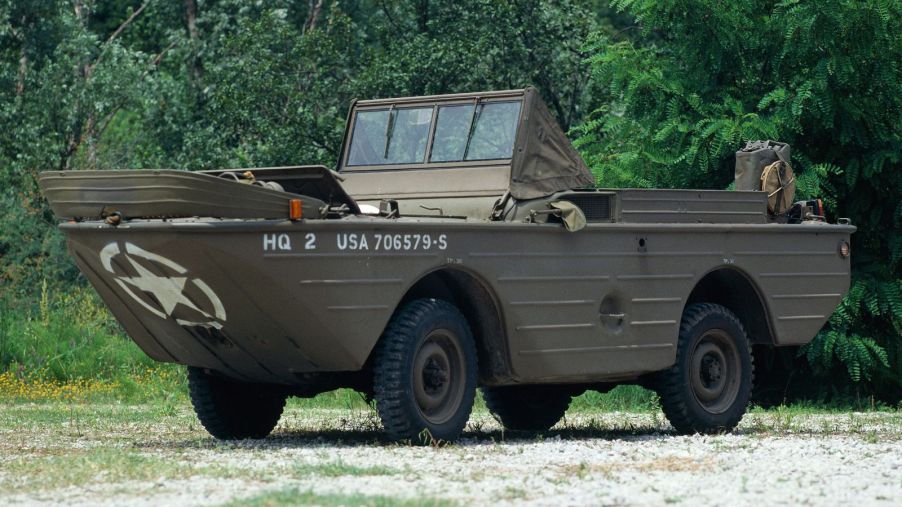
The Ford GPA, a floating derivative of the military Jeep, rolled off the line during World War II.
It drove on land and traveled across calm water. It saw limited success in U.S. service, but proved useful in certain Allied operations.
Ford’s legacy isn’t just the familiar lineup on today’s roads
It’s a long chain of unexpected leaps, odd experiments, and decisions that changed manufacturing and car ownership in the U.S.
When you stack the stories together, the company’s past reads less like corporate history and more like a Don Draper-esque startup.