6 Best Honda Engines, Ranked (And the Models You’ll Find Them In)
Honda’s been building internal-combustion gold for decades. These are engines that can outlive their owners, spin to motorcycle-like redlines, or sip fuel like they’re allergic to gas stations.
Here’s my take on the best Honda engines, ranked not by fan worship but by a mix of durability, technical merit, real-world performance, and where they fit in Honda’s broader engine evolution.
I’ll also point out which cars they powered (past or present), so you can spot them in the wild.
1. F20C/F22C1

This one redefined what a four-cylinder could be.
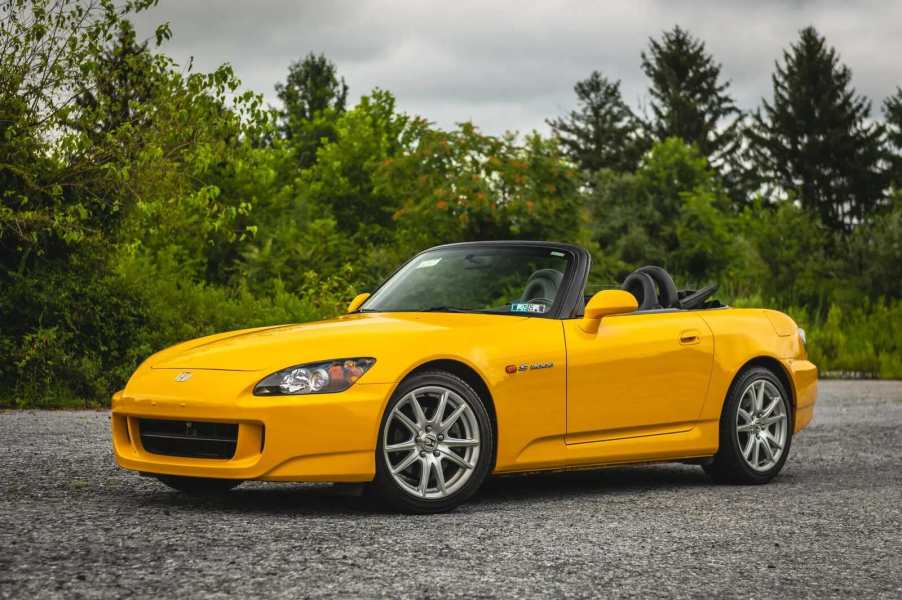
The F20C didn’t just power the Honda S2000. It was the S2000. When it arrived in 1999, it embarrassed larger engines with how much power it output. We’re talking roughly 124 horsepower per liter in production form, an output so outrageous it once held a world record for naturally aspirated engines.
The whole thing was a technical flex. Forged pistons, a massive 9,000-rpm redline, and Honda’s most aggressive VTEC system ever fitted to a street car.
In later years, the U.S.-spec S2000 switched to the F22C1, with a slightly longer stroke for better low-end response, but the same high-rev nature. For an engine that lives this close to the edge, its reliability record is remarkably solid. That is, if you feed it clean oil and don’t treat redline like a lifestyle.
To many, it remains the automaker’s most thrilling engine to drive, and one of the most technically ambitious four-cylinders ever built.
2. Honda K-Series

This is the “everyday hero” that can do it all.
If the F20C is a fireworks display, the K-Series is Honda’s backbone. Introduced in the early 2000s, it quickly became the company’s universal engine family. It’s found in everything from Civics and Accords to CR-Vs and even Acuras.
The secret is in its balance. These engines make strong power, stay reliable, and respond beautifully to tuning. The K20’s 2.0L block offers perfect geometry for revs, while the K24 stretches the stroke for torque without losing Honda’s trademark smoothness.
Technically, it’s a masterclass. Dual overhead cams, i-VTEC that adjusts both lift and timing, and robust aluminum construction. What makes it so beloved is how much it scales: bone-stock it’ll run forever, but with a few well-chosen upgrades it can make serious power.
You can daily-drive a K24 or drop a K20 into a project car and know it’ll take the abuse. Modern turbocharged versions, like the K20C in the Civic Type R, have carried that same DNA into Honda’s performance future.
3. B-Series

Okay, this one’s the engine that started the Honda legend in the U.S. market.
Long before the K-Series, there was the B. The B16 and B18C made Honda a household name among tuners in the 1990s.
These were the first mainstream Honda engines with DOHC VTEC, which let them behave like two engines in one. Mild and efficient down low, ferocious once VTEC kicked in.
The B18C5, which powered the Acura Integra Type R, is the hero of the group. It revved past 8,000 rpm, made roughly 195 horsepower from just 1.8 liters, and had the reliability of an anvil.
That engine helped define Honda’s “rev it, don’t replace it” culture. Even today, decades after production ended, the B-Series commands respect in the aftermarket world. They’re rebuildable, swappable, and endlessly tunable.
Sure, these engines require a timing belt and they don’t have modern refinement, but they built Honda’s reputation for high-rev precision. And, arguably, inspired the company’s best work that followed.
4. D-Series

The D-Series is the quiet workhorse that built Honda’s reputation.
If the F and B engines made headlines, the D-Series did the heavy lifting. Found in millions of Civics and CRXs through the 1980s, 90s, and early 2000s (don’t forget the Civic Del Sol), these small single-cam engines weren’t glamorous, but they were bulletproof.
Most of them barely cracked 125 horsepower, yet they ran for hundreds of thousands of miles with minimal drama.
The genius was in the simplicity. Lightweight aluminum blocks, low compression ratios that tolerated neglect, and basic SOHC layouts that anyone with a socket wrench could maintain.
The D-Series was cheap to build, easy to service, and nearly impossible to kill. It’s not an engine people brag about, but it’s one they remember fondly when their 25-year-old Civic still starts every morning.
5. Modern Honda turbo/Earth Dreams Engines

The future arrives…cautiously.
Honda’s modern turbocharged lineup, often branded under the Earth Dreams banner, shows how the company is adapting to emissions demands without losing its identity.
The 1.5L and 2.0L turbo engines in newer Civics, Accords, and Acuras bring impressive power and efficiency, matching or beating larger engines from the past.
The 2.0L turbo in the Civic Type R (a descendant of the K20C line) is especially noteworthy, proving that forced induction doesn’t have to mean dull character.
Still, these engines are complex. Turbocharging adds heat, pressure, and new maintenance concerns that old-school Honda owners never worried about. Their long-term reliability story is still being written. But it’s clear Honda’s engineers haven’t forgotten how to blend performance with civility.
The J-Series V6 gets an honorable mention

This one’s a smooth operator…with a caveat.
The J-Series V6 deserves mention for its torque and smoothness. It’s powered everything from the Accord to the Odyssey, and when properly maintained, it’s buttery smooth and lasts for ages.
But recent scrutiny from the National Highway Traffic Safety Administration has highlighted potential rod bearing issues in some 3.5L J35Y versions. Of course, that’s not representative of the whole line, but it’s enough to put a small asterisk next to its otherwise strong record.
For sheer day-to-day usability, though, the J-Series remains one of the most refined six-cylinders ever fitted to a midsize car. It just doesn’t carry the cult-engine energy of the F, K, or B families.
Honda’s history is full of brilliant engines
But the above stand taller the rest because they deliver more than horsepower. They capture an engineering philosophy. If the F20C is Honda at its loudest, the K-Series is the automaker at its smartest. And that’s why both still define what makes a great engine, decades later.