5 Ways to Tell if a Used Ford F-150 Has a Tow Package
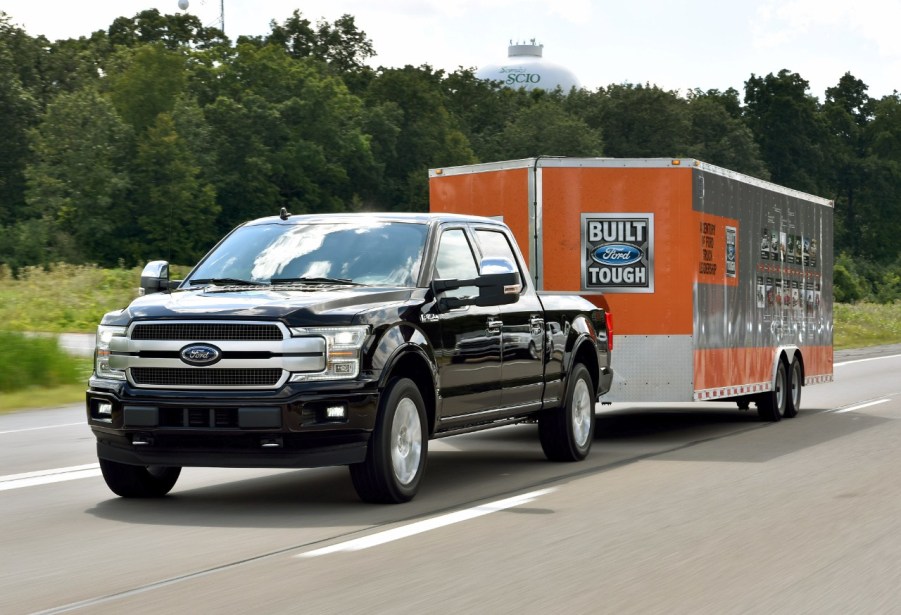
When you’re buying a used Ford F-150, it’s easy to assume they’re all built to tow. After all, the country’s best-selling truck has a reputation for hauling just about anything with a hitch.
But not every F-150 leaves the factory with a full tow package. Even though every truck is rated to pull roughly 5,000 lbs, that number can more than double if the right hardware was installed when it rolled off the line. The problem is, some buyers don’t realize that until they’ve already signed the paperwork.
Here’s how to tell if a used F-150 you’re eyeing has a tow package, and what it means
1. Check the original window sticker or build sheet
The simplest way to know what your truck was born with is to look at its Monroney label or build sheet.
If you see “Trailer Tow Package,” “Tow/Haul Package,” or “Max Trailer Tow,” then you’ve got the hardware needed for serious towing.
If you don’t, it’s likely the base setup, which can still handle small trailers but won’t be equipped for the heavy stuff.
The build sheet can be pulled using the VIN from Ford’s website or through a dealership’s service department.
2. Inspect the hitch receiver and rear bumper area
A quick crawl under the rear bumper tells you plenty.
A true tow-package F-150 will have a Class IV (2-inch) receiver with reinforced mounting points, heavy-gauge steel, and welded or boxed reinforcements.
You’ll sometimes spot a sticker showing ratings like “12,100 lbs with weight-distributing hitch,” which means the receiver is part of the upgraded factory system.
Trucks with only a light-duty receiver can still tow, but not safely past the standard range.
3. Look for a 7-pin trailer connector
A factory tow package almost always includes a 7-pin connector mounted next to the hitch.
That plug enables full trailer-brake control, turn signals, reverse lights, and auxiliary power.
If you only see a 4-pin connector, the truck was likely built for basic utility towing. The difference isn’t cosmetic. It’s what separates a light hauler from something rated to pull more than five tons.
4. Check for a trailer-brake controller inside the cabin
Pop your head into the driver’s seat and look at the dash near the steering column or infotainment system.
Trucks with the factory tow package include an integrated trailer-brake controller. It’s a small dial or toggle labeled “Trailer Brake” that adjusts gain.
Without it, the truck may still tow, but not with the same braking coordination or safety margin for heavy loads.
5. Use the VIN to confirm axle ratios and cooling upgrades
Every F-150 has a unique 17-digit VIN that can be used to verify what’s hiding under the sheet metal.
Entering it on Ford Pro’s VIN decoder or asking a dealer to check their system reveals exact options, including whether it came with the 3.55:1 or 3.73:1 axle, the larger radiator, upgraded transmission cooler, or electronic-locking differential. These are features tied directly to higher towing limits.
Trucks with the Max Trailer Tow Package (option code 53C in some model years) typically include those components plus a 36-gallon fuel tank for longer hauls.
You can also check the door-jamb tag for the axle code and cross-reference it online.
What the tow numbers actually look like
Over the years, Ford’s F-150 towing capacities have steadily climbed as powertrains and chassis tech improved.
In the mid-2010s, properly equipped models topped out around 11,300 lbs. By 2018-2020, the max climbed to roughly 13,200 lbs.
For 2021 through 2023, certain 3.5-L EcoBoost V6 SuperCrew 4×4 models with the Max Trailer Tow Package reached 14,000 lbs.
The 2024 and 2025 model years list 13,500 lbs as the official maximum when “properly equipped,” which includes the Max Trailer Tow Package, specific axle ratio, and 6.5-foot bed.
For example, page 12 of the 2025 Ford RV & Trailer Towing Guide tags the 3.5L EcoBoost V6 F-150 with a 13,500 tow capacity if it’s got the right package.
Those figures represent best-case scenarios under controlled conditions. A truck without the full package may top out at 7,000–8,000 lbs, even with the same engine.
If you’re towing only a small utility trailer, the base F-150 can do the job
But once you start talking campers, boats, or enclosed trailers, you’ll need the cooling, braking, and axle support that come with a factory tow package.
Skip it, and you could face overheating, brake fade, or even warranty issues if something fails under load. The difference between “it can tow” and “it’s built to tow” is thousands of pounds of stress the truck has to manage.
The most modern F-150s can tow up to about 13,500 lbs when properly configured. But you can’t assume every used truck on the lot is built for it. Do the paper check, crawl underneath, look at the dash, and run the VIN. A few minutes of detective work can keep you from discovering too late that your “tow-ready” truck isn’t ready at all.