We Can Hardly Believe the Estimated Range on Toyota’s New Electric Pickup
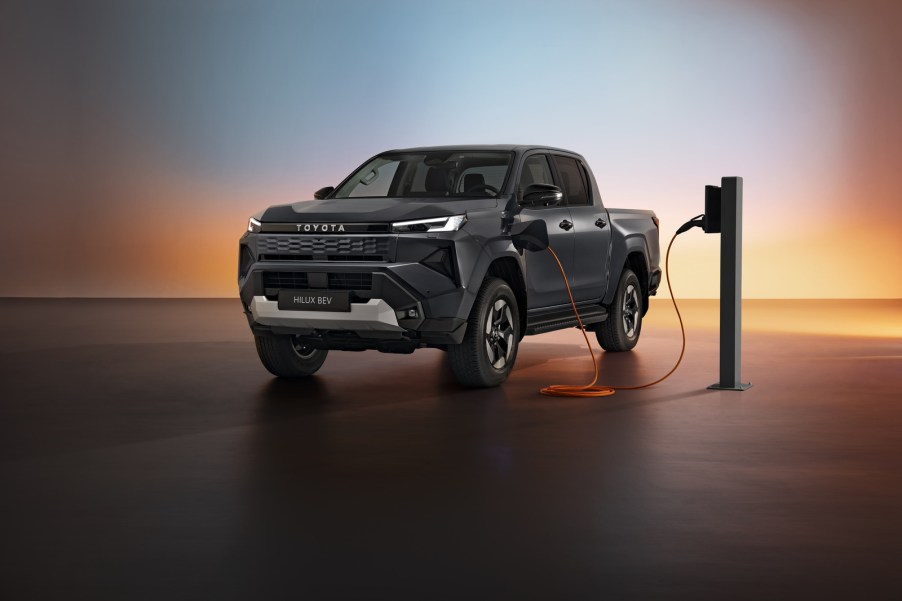
Toyota rolled out its first electric Hilux this week, and the news landed with the energy of a flashlight running on a dying AA.
The company framed the 9th generation of its iconic pickup as a step into a broader electrified future. And if you’re wondering where you’ve been all these years without seeing a Hilux, no worries. You’re not living where it exists.
And while I’m not one for covering non-U.S. market trucks much, when I saw the numbers, a thread opened up that speaks volumes. Its estimated range tells a story, one that feels more like Toyota is still just testing the water with a single toe after years of insisting hybrids were enough.
Or snubbing it.
The new Hilux looks the part
A far cry from its lean ancestors, Toyota reshaped the Hilux with a squared-up, beefy front end inspired by the latest Land Cruiser.
Per the UK world premiere press release, Every version now uses a double cab and electric power steering. The cabin gets a modern layout with a horizontal center stack and dual 12.3-inch displays, depending on trim.
Toyota also added a long list of new driver assistance features along with over-the-air updates. It’s a solid redesign.
Buyers outside the U.S. can bring home a gas, diesel, hybrid, or fully electric version. They ain’t cheap, either. In Australia, owners cough up somewhere between $53,000 and high-$70,000 for these things.
The problems begin when Toyota talks about the battery
The Hilux BEV uses a 59.2 kWh pack with motors on each axle. Pre-certification numbers suggest around 150 miles of WLTP range.
Well, okay. Maybe folks overseas don’t need to drive 300 miles one-way like we do. But Mashable pointed out that this looks low by European standards, too.
Toyota said this is still a true Hilux, with a 715-kilogram payload, 1,600-kilogram tow rating, off-road software, and a wading depth equal to the combustion model.
All of that matters. But customers buying an electric pickup in 2026 will expect something that can roam farther than a long grocery run.
And loaded down with passengers and cargo, that range drops like a wind-up toy running on its last few cranks.
See, the Hilux isn’t a compact truck
The model definitely was from birth to 2004. But since then, it’s classified as a midsize. That means it’s a direct competitor to, say, the Ford Ranger, not the Maverick (Ford’s compact offering).
The contrast gets sharper when you look at newcomers like Slate Auto. Slate is the American startup backed by Jeff Bezos, and its teensy minimalist electric truck carries a rear-drive layout with a single 201 horsepower motor.
The company reported an eight-second run to sixty, modest towing numbers, and a curb weight around 3,600 pounds. So, we’re talking tiny, here.
Nothing about it screams workhorse. Yet Slate still plans to offer two battery options that deliver either 150 miles or 240 miles of range.
By the way, that still sucks, relative to other EVs. The Tesla Model Y standard range is about 303 miles. The extended range option gets you to 330.
Even the cheaper battery matches Toyota’s Hilux EV figure.
The Slate truck is spartan…by design. You can pay extra for a second-row seat or custom touches, but Slate at least understands that range decides whether a pickup can function outside city limits.
Then there’s the Ford Ranger
The midsize Ranger occupies a smaller footprint and stops short at the gas and hybrid versions.
In the U.S., you can’t get the hybrid…just three different gas versions, a 4-banger and two V6s.
But Ford gives buyers efficiency, respectable payload ratings, and highway range that doesn’t require constant planning. The hybrid option gives drivers 435 to 466 miles before needing a fill up.
The Ranger also starts thousands lower than what analysts expect from the electric Hilux when Toyota announces pricing for the UK: In Australia, $36,880 AUD for the base Ranger XL model. That’s around $17k less than the Hilux.
Toyota confirmed a hydrogen fuel cell Hilux is coming in 2028, and the company insists its multipath plan will meet customers where they live
That may prove true. But the first electric Hilux feels like a half attempt. Toyota built a capable truck that’s lasted half a century. It just forgot that capability now includes range. Or…
Maybe Toyota knows what it’s doing with the Hilux, here, and realizes aching over range and cutting non-EV versions out of the lineup still isn’t worth it. I’m betting most 2026 Hybrid buyers will go for the other engines…possibly by Toyota’s design.