‘Is it really worth keeping?’ Experienced mechanic answers whether a Subaru with 100,000 miles should be trusted
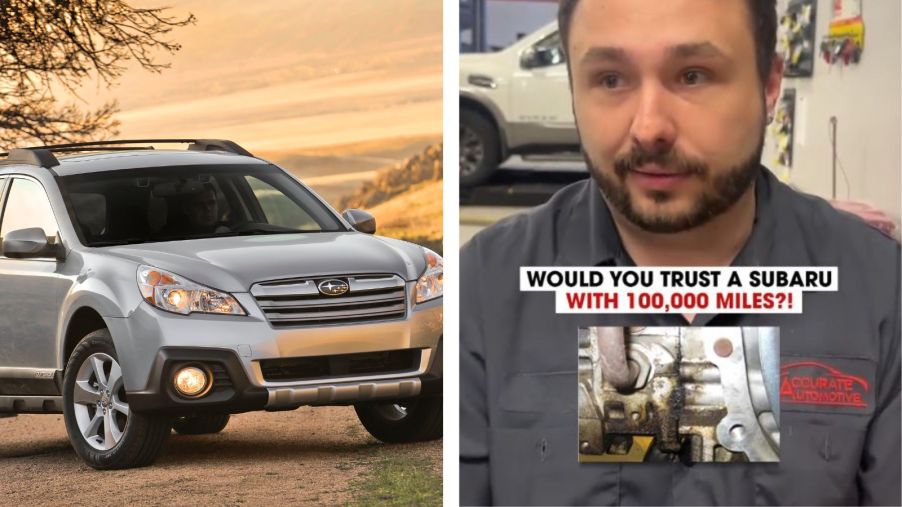
“Would you trust a Subaru with 100,000 miles?” It’s a simple question. But the shop owner, Alex Kacsh of Accurate Automotive in Northglenn, Colorado, has a thoughtful answer.
Subaru cars are known for lasting a long time, as long as owners keep up with maintenance. It’s not uncommon to see them hit 200,000 miles or more. That said, some issues tend to pop up right around that 100,000 mark, especially on models from the early 2010s.
Kacsh confirms the classic Subaru trouble spot: head gaskets
Older models with the 2.5L flat-four engine, especially from the late 2000s and early 2010s, often blow them between 80,000 and 120,000 miles.
If it hasn’t been done yet, expect a hefty repair bill. A head gasket job in 2025 runs thousands.
But, if you get the handy-dandy head gasket repair kit specifically designed to solve the factory issue, you’re golden for another 100k miles (at least).
Then there’s the CVT transmission
Subaru started using it heavily around 2010. Some early CVTs fail around 100,000 to 120,000 miles. If it hasn’t been flushed every 30k to 60k miles, you’re rolling the dice.
A CVT replacement can cost $4,000 to $6,000 (or more) in 2025.
Oil consumption is another fun Subaru quirk
Some 2.0L and 2.5L engines, especially pre-2016, burn oil faster than your wallet can keep up.
It’s usually due to piston ring issues. If it’s bad enough, the fix involves a full engine rebuild or replacement, which, again, runs thousands.
Despite that, many Subaru owners still swear by their cars
The comment section on @accurateautoinc’s Subaru reliability TikTok lit up with proud owners touting way more than 100,000 miles.
“256,000 miles on our 2010 Outback.”
“2016 Subaru Legacy approximately 196,000 miles. I have been very fortunate. Thank you God.”
“239,000 miles on our 14′ outback. No head gasket issues, just basic maintenance.”
A former Subaru tech added his piece on the redesigned engines: “I used to be a Subaru mechanic and can definitely say the newer FB and FA engines that replaced the old EJs did not have head gasket issues. Yes some of them have had head gaskets failures but it’s not common and doesn’t happen anymore frequently than any other vehicle.”
If the service records are clean, the engine is leak-free, and the CVT shifts smoothly, it can still be a solid bet. But if the seller says, “It just needs a little oil now and then,” that’s code for run.
MotorBiscuit reached out to @accurateautoinc via TikTok direct message for comment.