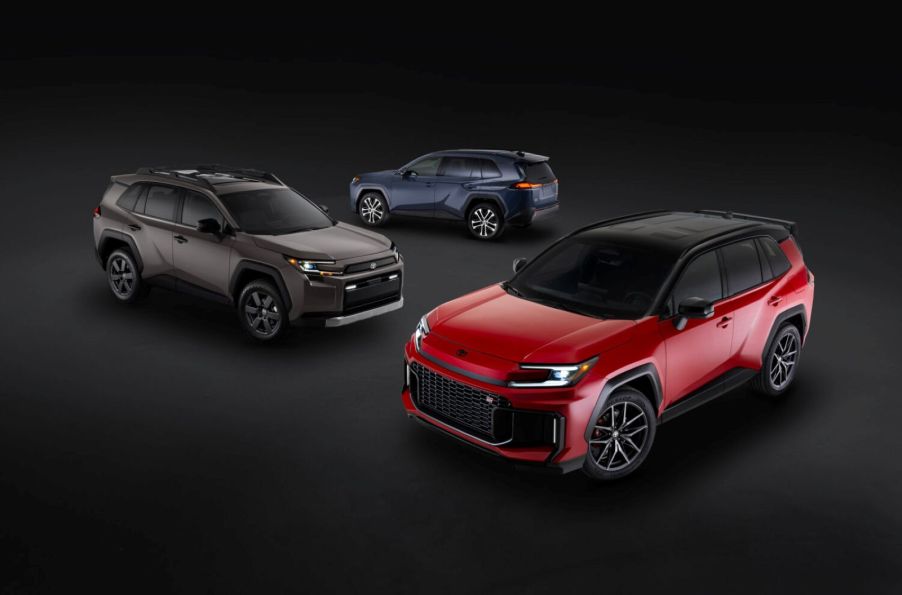
Why does Toyota say the new RAV4 is ‘100% electrified’ when each model has an ICE?
Toyota unveiled the redesigned sixth generation of the RAV4 SUV on Tuesday. With the announcement came the latest in sneaky PR vernacular. In the press release from the company, it reads, “America’s best-selling compact SUV will now be 100% electrified.” If you’re like most normal people, you read that and thought, “Wow, the new RAV4 is an EV?”
I read it and immediately started looking for information as to how big the battery is, if it’s AWD, and whether or not it will have an NACS charging port so it could utilize the Tesla Supercharger network.
But then I kept reading. Immediately following “100% electrified,” the release reads, “in a choice of Hybrid Electric Vehicle (HEV) or Plug-in Hybrid Electric Vehicle (PHEV) powertrains.”
Well, now, Toyota. That’s not what ‘100% electrified’ means. What they should have written was, “100% of new models are electric to some extent.” After all, 100% of the 2026 RAV4 trim levels use Toyota’s tried and true 2.5-liter four-cylinder engine. They could have even said, “Each 2026 model will have an electric battery.”
While it’s technically true, it’ll likely confuse folks who don’t read the whole thing
It’s not just Toyota’s fault, either. Plenty of headlines read that the new RAV4 is “all-electric,” which is a tad misleading. Since we all know people don’t usually read further into an article than the headline, it wouldn’t be shocking to learn that some people walk into a Toyota dealership when they become available later this year and ask for the RAV4 EV.
Then dealership employees will have to explain that ‘100% electrified’ doesn’t mean an EV, but rather, a battery. Which technically isn’t false, but it can be a little misleading to some. Sort of like Tesla calling a semi-autonomous driver assist software “Autopilot.”
It’s not completely false, but it’s not completely true, either.
Marketing jargon aside, there’s plenty to be excited about
Since the first model year in 1996, the Toyota RAV4 has charmed, delighted, and surprised millions with its cargo space, capability, and reliability. There’s probably a handful of people with the first model year considering finally upgrading after the odometer rolled to read 450,000 miles.
This time around, the PHEV’s battery technology has been upgraded to have 50 miles of all-electric range, and 320 combined horsepower—that’s over 100 ponies more than the current PHEV. Additionally, Toyota added a GR-Sport trim, which is mostly an appearance package designed by GAZOO racing, but it’s quite handsome.
It comes with front and rear spoilers, wide 20-inch model-exclusive wheels to accommodate wider and stickier summer tires, tighter suspension, heightened steering, improved body roll, and a feistier throttle response. No updates to the engine are needed, since it’s PHEV only, and that boasts 320 horsepower.
The Woodland trim has been upgraded, too. For the first time, the Woodland can be bought as a PHEV, while the previous edition was HEV only. It still comes with all-weather cargo and floor mats, all-terrain tires, a model-exclusive gray paint color, black wheels instead of bronze, and blacked-out exterior trim pieces.
The HEV has been improved, too. New HEVs can now come in FWD, while it was previously AWD only. That powertrain saw a boost in horsepower, too. In FWD, it makes a combined 226 horsepower, and AWD models see 236 combined horsepower.