Study says Americans can’t fully adopt EVs until they stop putting everything but cars in their garages
“I’ll just put it in the garage,” you say about the extra box of knick-knacks that won’t fit in the basement. After all, you might need something out of it later, and who even has the time or energy to sort and donate items today? If this sounds familiar, and you’ve also thought about buying an electric vehicle, well, you might have more trouble than you’d think. Apparently, too many Americans aren’t in the mindset to make room for them. A new study says cluttered garages across the U.S. are quietly choking off EV adoption, and the numbers paint a sobering picture.
Researchers at Telemetry, led by vice president Sam Abuelsamid, analyzed the state of home charging and its role in long-term EV growth. They found that while charging networks and government policy often get the headlines, everyday parking behavior may be the overlooked barrier.
Most EV owners charge at home, with about 80% of sessions taking place on AC power
But that requires a 240-volt outlet and a place to park near it. For many homeowners, the latter is harder than the former.
Data from the National Renewable Energy Laboratory shows that 42% of homeowners already park close enough to an outlet for level 2 charging. The Telemetry report claims that number could jump to 68% if people simply cleared their garages.
That shift would expand the number of homes capable of EV charging from about 31 million today to more than 50 million. If wiring upgrades are included, the potential climbs to 72 million. That’s well above even the most optimistic forecast of EV adoption by 2035.
The challenge is that wiring upgrades aren’t cheap, and nearly 34 million homes would need electrical work to handle a level 2 charger
Those projects can run thousands of dollars, sometimes more than the fuel savings of switching from gas.
Families weighing ownership costs might conclude that the math seems less than favorable.
For Americans in apartments, condos, or townhomes, the situation is tougher still
About 23% of the population lives in multifamily dwellings, where adding chargers requires landlord or board approval. In many cases, electrical infrastructure upgrades are seven-figure projects. Even with mandates requiring EV-ready parking in new developments, Telemetry forecasts that supply will lag far behind demand.
That means millions will remain dependent on public charging.
Telemetry projects that by 2035, the U.S. will need more than half a million DC fast chargers and up to 1.6 million additional level 2 chargers to meet demand. But energy competition from AI data centers and strained grid capacity make that a tall order.
Americans don’t just need incentives and infrastructure. They need to reclaim their garages (and, I’ll add, their wallets)
Until then, the nation’s EV adoption curve may stay parked in neutral.
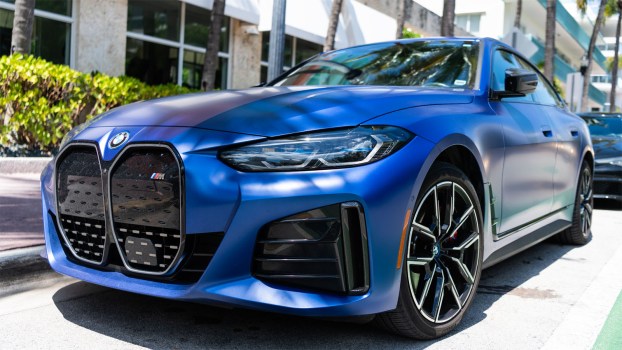
And I’m witness to this phenomenon. In my own neighborhood, several homeowners have EVs. They’re often parked outside, in front of two or even three-car garages. The neighbors string thick, all-weather extension cords out to charge them. One looks like a garden hose, wound up on a wheeled cart to reach their BMW iX, which they park behind several other cars in the driveway.
Oh, and by the way, not to sound like a showoff, here, but we’ve made it a point to park both our cars inside our garage, now that we have one. See, I grew up in what some might call a “cluttered” home. I can’t recall a time either of my parents parked their cars in the garage. It was always too full.
When I moved out to Chicago, my apartment had exactly zero parking. None of my subsequent apartments had covered parking, either. Eventually, Drew and I bought our first home in Downtown Columbus, and we were happy to have off-street parking. Uncovered and on gravel, though, it wasn’t the best.
Soon after, around 2016, I found a documentary on Netflix called “Minimalism” starring Joshua Fields Millburn and Ryan Nicodemus. That film validated my inner anxieties about our deep-seated consumerism and Americans’ tendency to never stop accumulating. That “we’re never done buying” mindset extends to debt, too, including car loans. From being in the industry, I’d already learned that they can trap Americans in a doom spiral of never-ending payments.
Once we moved to a nearby suburb, we finally had a garage. I was so excited to press a button and watch the door open or close. I even filmed Drew pulling his car into it for the first time. Five years in (and a Fiat 500, Range Rover Evoque, and Acura MDX later), and we still make sure the garage has enough space for both of us to park.
By the way, that perspective-shifting documentary I mentioned had 80 million views on Netflix. Now, it’s free to watch in full on YouTube. I linked to it above.
EV adoption also requires excellent financial health and accessible resources, for drivers AND automakers
EVs are still far from the cheapest option. The 2025 Tesla Model Y, for example, starts at $46k and goes up to $53k. If someone buys it and decides they don’t like it after a year or two, well, they’re almost assuredly stuck well underwater. A 2023 Model Y might only have a $21k trade-in value. You might have upwards of a $9,000 gap between that and your loan balance. If you have a high-interest loan and a large car payment, that gap would be even worse.
Sure, it’s the same with any other new car. But arguably, it’s much easier on the wallet to go and purchase a reliable used car, like a Toyota RAV4 or Honda CR-V, than switch to an EV before your county or state is really ready.
With the tariffs and difficulty building EVs en masse for a decent profit, automakers have turned the volume down on their production commitments, too.
Access to road-trip level charging, worry-free maintenance and repair centers, and even automaker hesitation to dive fully and completely into EV lineups has everyone looking at hybrids, anyway. Heck, the 2025 Toyota RAV4 Hybrid starts at $32,600.
I’m not saying EVs are terrible. But I think we have a whole lot else to work on first, including falling out of love with stuff…including brand-new cars and debt. What happened to “Use it up, wear it out, make it do, or do without?”