A shop owner just handed us a list of 21 dirt-cheap used cars with bulletproof reliability
The other day, I wrote a piece on Matthew Johnson’s advice for keeping an old beater running indefinitely. He posted the video on social media, and it had some very solid pointers. After all, he spends a lot of his time wrenching on old-school metal. See, he runs Doc Johnson Restorations, a professional restomod shop nestled in Klamath Falls, Oregon. I reached out to him for comment, and in his reply, he kindly offered to draw up a special list he keeps in his back pocket. We’re talking about cheap – very cheap – used cars that actually hold up.
Of course I told him we’d take whatever he’d jot down for us. Days passed. Early this morning, though, a present showed up in my inbox, direct from Oregon.
Heck, we all know bringing home a really used vehicle is a risk
These are cars, trucks, and SUVs that have probably already taken a good beating before you thought to go out looking. But Johnson swears that certain easy-to-find makes and models fly under the radar these days, some even sitting in junk yards, while quietly offering bulletproof reliability to the few who know about them.
Now, Matthew pointed out that you won’t see certain fan favorites on his list. He says he might get some flack for it, but hear him out: Toyota Tacomas and 4Runners are great, obviously. But the key, in his mind, is price point. In his words, “If you happen upon a good deal with a 4runner or Tacoma…jump on it.”
Without further ado, here are all 21.
Used cars that won’t fail you, even after 30 years of daily driving
Buick LaCrosse with the GM 3800 V6

That old GM 3800 engine is nearly unkillable. It’s a simple pushrod V6, easy to service, and it shrugs off miles. The LaCrosse of this era ran with about 200 horsepower through a four-speed automatic, and the drivetrain is known for crossing 250,000 miles without drama.
1990s to 2000s Toyota Camry (4-cylinder preferred)

The four-cylinder Camry is the budget king, though the V6 isn’t a bad option either. These cars used 2.2- and 2.4-liter inline-fours that were cheap to run and dead simple to repair. They had a quiet ride, roomy interiors, and a reputation for stretching paychecks with low-cost maintenance.
Saturn Ion

The Ion didn’t win on style, but it’s rugged. GM killed the Saturn brand in 2010, but these cars carried 2.2- and 2.4L Ecotec engines, wrapped in bodies with plastic panels that don’t rust. The cabins were basic, but these cars still show up under $3,000 in decent shape, which makes them hard to ignore.
Toyota Corolla

The Corolla barely needs an introduction. Its 1.8L four-cylinder is legendary for reliability, and most models return over 30 mpg without asking for much more than oil changes. Maintenance is simple, which is why Corollas seem to live forever in classifieds.
Ford Crown Victoria

The Crown Vic is the retired cop car turned bargain. Built to idle all day and drive all night, it used a 4.6L Modular V8 and rear-wheel drive with a full body-on-frame layout. Heavy-duty suspension kept them tough, and parts are everywhere thanks to years of fleet service.
Lexus LS400 / LS430

Johnson called these some of the best-made cars ever. The LS400 and LS430 used 4.0- and 4.3L V8s with rear-wheel drive and smooth five-speed automatics. Interiors and electronics held up far better than most luxury cars of the era, and they still feel overbuilt decades later.
Pontiac Vibe

The Vibe is basically a Toyota Matrix in disguise, but usually cheaper. It used Toyota’s 1.8L four-cylinder, offered optional all-wheel drive, and packed hatchback practicality. The Toyota engineering under the Pontiac badge makes it a steal.
1990s to 2000s Honda Accord (4-cylinder preferred)

The four-cylinder Accord keeps costs down, though the V6 was available too. These cars used 2.3- and 2.4L engines with smooth-shifting manuals or automatics. Balanced chassis tuning and straightforward maintenance kept them in family driveways for decades.
1990s Toyota Celica

The Celica from this era was light, simple, and tougher than it looked. Most came with 1.8- or 2.2L four-cylinder engines, often paired with manual transmissions. They remain fun to drive and cheap to keep alive.
SUVs: The durable picks
GMT400 and GMT800 Chevy Tahoe & Suburban

Johnson pointed out that the three-quarter-ton Suburbans are even better buys because they came with heavier-duty transmissions, axles, and suspension. The 5.7L and later 5.3L V8s are common, and the stout 4L80E automatic in the HD versions makes them even harder to kill.
Toyota RAV4

Nearly every generation of the RAV4 has proven solid, though some engines are known for oil consumption. These small SUVs used 2.0- to 2.5L four-cylinders, often with available all-wheel drive. They were compact, simple, and dependable.
Jeeps with the 4.0L Inline-Six

The 4.0L inline-six is one of Jeep’s most famous engines. Most Cherokee XJs are beat by now, but clean Grand Cherokees still pop up. The cast-iron block and straightforward design keep them running well past 300,000 miles.
1st-gen Toyota Sequoia (2001 to 2007)

The first-generation Sequoia came with a 4.7L V8, rear- or four-wheel drive, and a roomy interior that could tow with ease. It’s a big SUV with Toyota’s usual reliability baked in.
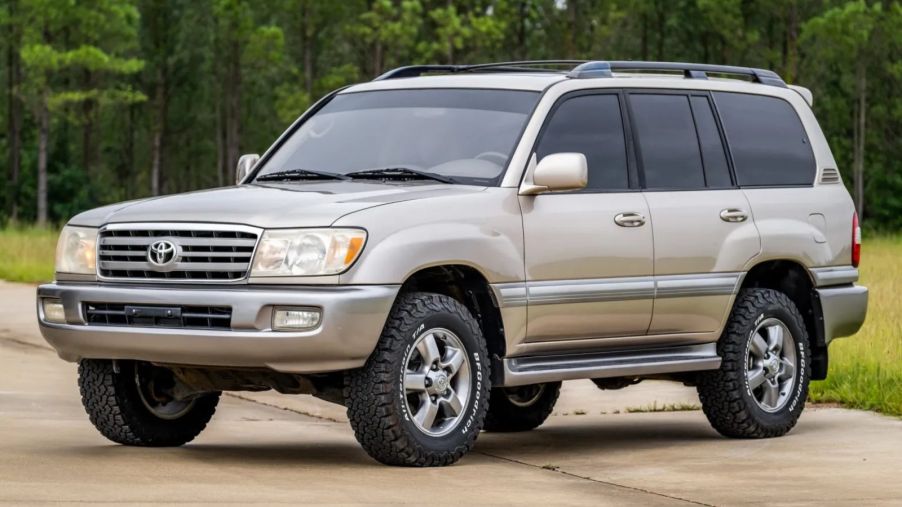
Toyota Land Cruiser LC100 (1998 to 2007)

Johnson called these a killer buy right now. The LC100 ran the 4.7L V8 with full-time four-wheel drive. Built for durability above all else, it became one of the most respected SUVs ever made.
1980s to 1990s Ford Bronco

These Broncos were built like tanks. Engines included the bulletproof 300-cubic-inch six and Windsor V8s, often paired with manual transmissions. The rugged frame and old-school design make them simple to keep alive.
I’ll add a note to this one: go for 1986 and newer for fuel injected versions. You might not want to mess with carburetors and all that. If you’re wary of OBD I, stick to 1996 and on to get OBD II (standard modern) diagnostics.
The shop owner gets particular on trucks
Ford pickups with 300ci inline-six (1980–1996)

Johnson swears by these. The 4.9L straight-six was paired with early four-speeds or the ZF5 manual, both of which were excellent. Avoid the Mazda-sourced five-speeds from later years, but otherwise these trucks are unmatched for durability per dollar.
GMT400 and GMT800 pickups

As mentioned in the SUV section, from half-ton to one-ton, both the GMT400 (1988 to 2002 Chevrolet C/K and GMC Sierra pickup trucks and the Chevrolet Tahoe, Suburban, GMC Yukon, Suburban, and Cadillac Escalade SUVs) and GMT800 (1999 to 2007, same models, add the Avalanche) were well built.
Engines ranged from the 5.7L small block to the 6.0L V8 and various diesels. Johnson prefers the heavier-duty versions for their stronger frames, drivetrains, and transmissions.
1st-gen Toyota Tundra (2000 to 2006)

The original Tundra came with a 3.4L V6 or 4.7L V8 and manual or automatic transmissions. It flew under the radar when new, but reliability has made it one of Toyota’s unsung heroes.
Ford Super Duty with 7.3 Powerstroke (1993 to early 2003)

The 7.3L Powerstroke V8 is still the diesel truck benchmark. It came with either manual or automatic transmissions, and many examples have run well beyond 500,000 miles. The Excursion, Ford’s beloved full-size SUV, got it too, so don’t leave that out of your search.
Bullnose / Bricknose / OBS Ford pickups

Spanning the 1980s through 1997, these trucks carried everything from gas V8s to the legendary 7.3 diesel. Johnson likes the 300ci six and the 7.3 in particular. Simple electronics and rugged frames make them easy to revive.
Ford Ranger (2.3L or 4.0L OHV)

The Ranger kept things small and tough. Engines included the 2.3L four-cylinder and 4.0L OHV V6, paired with manuals or automatics. They’re cheap to buy and even cheaper to keep on the road.
For the cherry on top here, Johnson also sent some excellent dad-level advice on shopping for any of the above used cars.
Shop owner’s used car buying advice
His rule of thumb: don’t pay “maintained car” prices for a car that needs all the maintenance
He suggested bringing a $10 vacuum gauge and a coolant pH tester when looking at cars, checking for blow-by at the oil cap, and giving every candidate a hard, long test drive. I’ll that if any of those words just now sounded too science-y, have a trusted mechanic do them.
Johnson warned against rust more than anything else, calling it the one problem you can’t wrench your way out of.
And if a deal doesn’t look right? Walk away. There are tons of these used cars out there, and another one always seems to pop up.
Once you’ve secured of these, come back and read the article I linked to in the intro above. Matthew gives maintenance tips inside that’ll actually trigger the reliability you’re looking for. The acronym is “BORING,” but after working in a shop servicing used cars for a decade myself, the advice is pretty spot-on.