Semi-truck driver shows us how long it really takes to hard brake at 70 mph [Video]
Roadside Truck specializes in heavy-duty towing. It helps commercial drivers and their companies keep fleets moving. The service recently shared a video of a semi-truck driver educating the rest of us on just how much road these professionals need to slow to a stop in the event of an emergency. And it’s nothing short.
NHTSA reports show that large trucks are involved in about 60,000 rear-end crashes each year
Between 2017 and 2019, nearly 400 people died and around 30,000 were injured in these kinds of car accidents. Most of the deadly ones happened at speeds above 55 miles per hour. That’s when trucks are hardest to stop and when smaller vehicles often misjudge how much space they need to avoid a crash.
The Federal Motor Carrier Safety Administration also highlights that rear-end collisions make up a big share of all large truck crashes. Hard braking is a common trigger. And on the highway, things happen fast. If a truck driver slams the brakes, anyone following too closely has very little time to react.
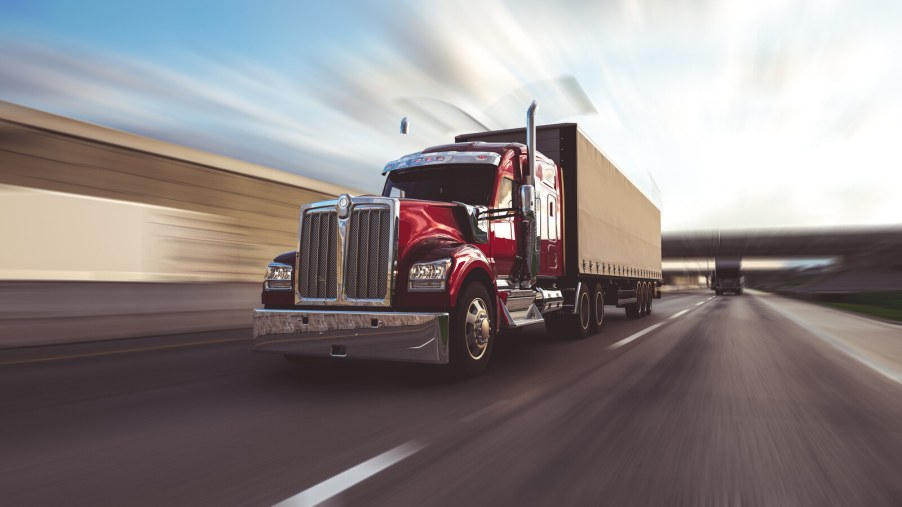
Semi-trucks need hundreds of feet to stop from freeway speeds, which means disaster in many hard-brake cases
At highway speeds (around 65 mph), a fully loaded semi‑truck grossing up to 80,000 lbs typically requires about 525 feet to come to a full stop under ideal conditions. That’s two football fields.
That matches more current findings, too: a recent source confirms 65 mph stopping distances around 525 feet, so that number is solid. Heavier loads or poor road conditions can push it even farther.
If you’re driving a bit slower, say 55 mph, you need about 196 feet under perfect conditions, according to Federal Motor Carrier Safety Administration guidelines.
But remember, that’s braking alone. Add perception and reaction time, and it grows. In actual real‑world scenarios, truck drivers operate off air brakes, which require extra “lag time” to build pressure.
Emergency braking rules set by Federal Motor Vehicle Safety Standards (via the NHTSA) back in 2009 say a fully loaded tractor‑trailer at 60 mph must stop within 250 to 310 feet, with lighter loads around 235 feet to clear test thresholds.
But again, those tests exclude perception and reaction: they strictly measure braking distance.
Real driving conditions aren’t always ideal
Wet roads, worn tires, brake fade on long downgrades, alertness of the driver…all these eat into the stopping margin. A dry day may allow 525 feet at 65 mph, but a wet highway? It could double.
Here’s what matters: for safety, semi‑truck drivers usually keep a 6 to 8 second following distance at freeway speeds. This translates to around 850 to 1,000 feet of real spacing behind another vehicle. That buffer gives them enough reaction time and braking space, even when conditions go south.
Regular drivers need to give semi-trucks extra space
A safe following distance is about six to eight seconds behind a semi-truck. That gives you enough time to see brake lights and respond. It also gives the truck driver some breathing room. Remember, a semi’s blind spots are huge. If you can’t see the driver’s mirrors, they probably can’t see you either.