Say Something Like This, and I’ll Know You’re a Car Person
If there’s one thing I’ve learned being around lots of true car folks, it’s that at some point, imposter syndrome seizes us all. The root cause, in my opinion, is just how stinking huge the automotive world is.
There’s an immense universe of vehicle classes, design and engineering history, and near countless arenas to play in
Off-roading and overlanding, supercar horsepower and 0-60 times, engine upgrades and swaps, truck trim levels and towing capacities, build kits, industry shifts, recalls, tuning, best-in-class lists, EVs, classics, motorsports (like NASCAR, F1, derby, desert, drift, drag, and rally, to name just a few), new car reviews, automaker movements…and on and on.
Dive deep in one area, and you’ll feel like you have some sense of your space. Peek into another, though, and you realize your ant-like stature in the grand scheme of “car stuff.”
But that’s also exactly the addicting thrill of it.
I grew up around cars and the aftermarket world in the Midwest, but I took maybe 20 years as a professional to start calling myself a car person
See, I didn’t realize that combing through Chilton repair manuals as a kid made me a car person already. I originally did it out of boredom. I don’t think any of my siblings even touched them.
I didn’t realize that spotting and appreciating neat examples of cars their owners had clearly handpicked made me a car person already.
I didn’t realize, as a teen, working alongside mechanics and finding interest in whatever they were doing under a lift made me a car person already.
I didn’t realize that, as a service advisor with a few years at the counter, having a favorite set of cars or an opinion on generational differences in model dependability made me a tenured car person.
This was partially because I didn’t organically arrive at “cars”
My dad opened his own shop in the 80s, so it was a “third place” to me. He grew up in an affluent suburb and graduated from college with a degree in accounting, having breezed through advanced math courses. Not exactly what you’d call a blue-collar guy, to say the least.
He had a batch of girls, by the way. I’ve heard from my mom that he didn’t want to stop until they had a boy, but stop they did at four of the opposite. And while I’m not saying he put us on a pedestal, it took him a while to grasp that maybe we would love cars, too.
Growing up, he talked a lot about going to college, maintaining financial stability and general independence throughout life, and other more intellectual ideas. My older sister was pressured to go to medical school (she didn’t, and makes a bigger salary than any of us). I was supposed to go to law school (I didn’t).
All things considered, my dad parented upon us some very useful concepts.
He never wholeheartedly invited me to help him fix a car. It was more “here, hold the flashlight” because he happened to have us along that weeknight or Saturday afternoon.
I ended up graduating with an English degree (dad wasn’t happy about that, but it all worked out). Favorite hard-knock novels like “The Grapes of Wrath” fed me well while I worked in insurance. By the way, I’ve argued that Steinbeck’s classic is really a car book.
But shops are dirty, often too hot or too cold, and the work is tough and sometimes dangerous.
Still, as I moved away from academic obligations, I read more writers who worked hard in not-so-pretty arenas. Ones who spoke in fresh, beautiful, insightful ways. Anthony Bourdain, Jon Krakaur, Steven Rinella, Cheryl Strayed, and Larry McMurtry.
I returned to the shop full-time after my grandpa got very sick
It was, sadly, the kind of ill that’s One-Way Only. I was working a near-intern-level job I didn’t feel particularly fulfilled in. My dad wanted to spend time with his dad in the hospital. I knew how to answer the phones and drum up estimates on a basic level. It was all good enough for both of us.
My grandpa passed away not long after I took over the counter. My dad grieved and, it seems, realized he hadn’t had to come back to work the front.
In the meantime, to learn how to take care of customers well and tow a reasonable profit margin, I pored over training materials and stared at diagrams of vehicle systems. I read all the TSBs the techs flagged and explored forums on all manner of head-scratching car problems. The team in the back helped me understand parts, repair procedures, and maintenance intervals.
Over the next couple of years, I got ASE certified, became a licensed car salesperson, and learned how to build a mobile-friendly website. I took leadership classes and, importantly, started to really appreciate just how intelligent, skilled, patient, and hardworking good mechanics are.
I also learned that I’ll never know it all when it comes to cars
It’s just physically impossible.
These realizations would help me as both a manager and writer. And, I’ll argue, assisted me in my personal relationships, too.
Because “it’s all hard” if you’re trying to do a good job, wherever the task is. In my book, it’s important to wake up every day and try. To go for something. To dive deep in an area outside yourself.
Do that, and you’ll be surprised at how many other people walking the Earth are trying to do the exact same thing. They’ll become your friends, too, and root for you.
And, these days, I’m quite comfortable calling myself a car person. It probably took me too long, though.
So, then. At some point, I’m going to have to deliver on the title, no?
Well. I’m writing this to tell anyone who’s even partially set themselves down any of the “car universe” pathways I listed above to feel comfortable here. Even if you haven’t or won’t ever do everything on the following list.
There are certain signifiers a true car person emits. Say or do any of these things, and I’ll know you’re one of us:
You watch car content. Top Gear, Comedians in Cars Getting Coffee, F1: Drive to Survive, Donut, Doug Demuro, etc. If you like that stuff and want more, try Westen Champlin, M539 Restorations, and RevZilla, to name only a few of the talented and passionate content creators out there.
You remember the cars from your childhood fondly. Make and model-specific. Bonus points if you know the year and trim level. You’ve also probably looked them up as an adult to learn more about them.
You have a favorite car or vehicle class, and can probably speak a coherent sentence or two on it.
When a shop tells you that your car needs something, you either already know what they’re talking about, or you go and look it up in order to better understand that component.
You’ve got opinions. For instance, which generation [insert car brand] engine, transmission, trim, or body style is the Best of All Time. Or that, while you might not drive an EV, you’ve come to understand that they’re probably here to stay and that we’re working on optimizing them and our infrastructure.
On that note, you might love or hate the Tesla Cybertruck, but you still gape at any you spot in the wild. I sure do.
You work in the car world and find the actual “car stuff” interesting.
Here are some more “technical” signals:
You may handpick your cars…and your family and friends are sick of hearing about them.
You might closely follow new releases (trim levels, editions), including specs and pricing.
You probably know the difference between a cold start and worrisome engine noise.
You actually subscribe to automotive channels or site newsletters, and follow “car people” on social media.
You can differentiate burning coolant and burning oil smells.
You hang out on r/[model].
You know whether a suspension component is critical (tie rod) or more for comfort (sway bar link).
You’ve tried (and eventually succeeded) at some DIY car repairs or upgrades.
We’re all car people, anyway
If you live in the U.S., you probably use a car often. In that sense, then, most Americans are car people by default.
Having worked at a general repair shop for a decade-plus, I found that if a driver didn’t lean into that concept at all, they were in for more perceptively expensive, frustrating events when it came to their vehicle.
In any case, please don’t ever be afraid of hanging out with car people. If you want to in the first place, I bet you’re already one yourself.
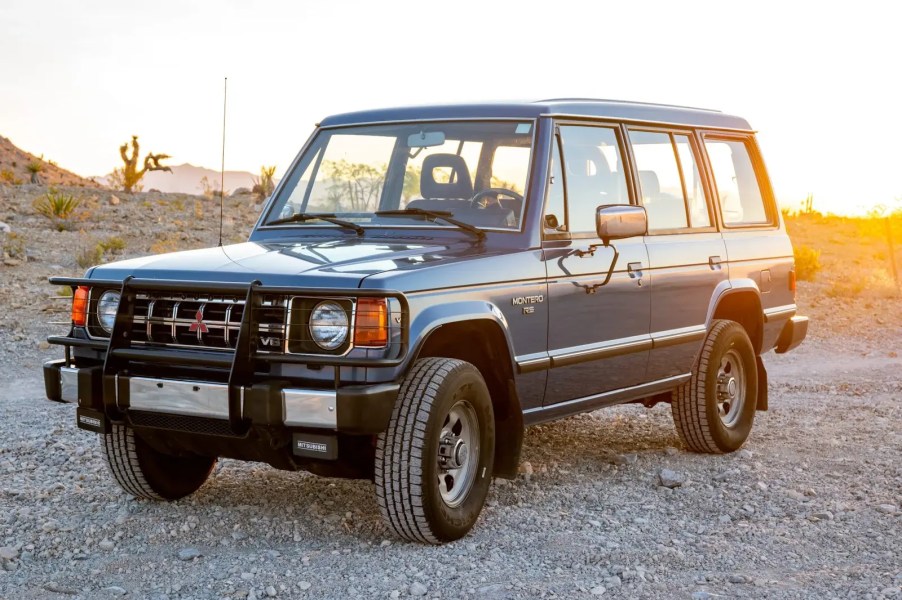
By the way, the SUV in the featured image is a 90s Mitsubishi Montero. One of my childhood cars.