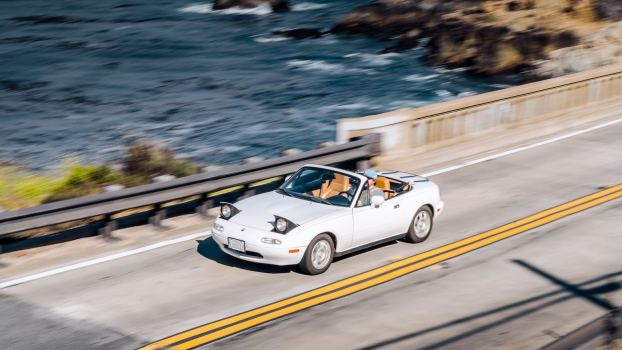
Pop-up headlights are form of hidden headlamps that fold up out of a car’s front end. They have achieved cult status as an icon of 1980s and 1990s car design. I can’t tell you how many times someone at a RADwood show has told me that modern cars don’t have cool pop-up headlights because the government made them illegal. But that’s only a half truth. In fact, two mass-produced cars still had pop-up headlights into 2004. And one production car still has hidden headlamps.
When was the last mass-produced pop-up headlight?
In 2004, both the Lotus Spirit and Chevrolet Corvette had pop-up headlights. Both automakers redesigned these sports cars for 2005 without the pop-up headlights. But that’s not because of a regulation change making the design illegal in 2005.
To me, 2004 is an awfully recent year for a stereotypically 1980s feature to still have been in mass production. By 2004 we had many “modern” car designs already in mass-production such as the new VW Beetle and Mini Cooper. The retro Ford Mustang and Toyota’s FJ Cruiser both debuted at the Detroit Auto Show in 2003. Meanwhile, you could still walk into a dealership and get a brand new car with pop-up headlights. Talk about world’s colliding!
The death of the pop-up headlight
By 1940, headlight design was a mess. Cars were getting faster, but many still had dim, rudimentary headlights without much reach. Automakers used proprietary headlight housings, many of which leaked and were prone to shorting out. Beginning in 1940, the government required every new car two use standardized headlamps. Each was a fully sealed beam, bright and waterproof.
By the late 1960s, auto designers were cursing the same sealed beams. Because there were limited sizes and shapes to choose from, the law limited how creative they could get with the front of vehicles. They could choose two or three headlights, and rectangles or circles. That was it.
Vehicles such as the Dodge Charger featured hideaway headlamps, with headlamp housings that spun around during the daytime. This gave the car the illusion of a full-width grille when the lights were off.
By the 1980s, many buyers wanted aerodynamic front ends similar to the wedge-shaped European supercars. But where do you put the sealed-beam headlamps? In pop-up headlight housings, of course.
So what happened to pop-up headlights? Ford Motor Company lobbied the government to allow proprietary headlights again. This change gave the 1986 Ford Taurus its revolutionary aerodynamic shape. And it opened the floodgates for new car designs.
In the last four decades, technological advances have allowed ever-smaller headlights. The latest LED headlights are razor thin and brighter than anything available in the 1940s. The result is an unprecedented number of options for car designers.
Are pop-up headlights legal?
Yes, an automaker is allowed to design a brand-new vehicle with pop-up headlights. But there is a major regulatory hurdle. The United Nations’ Economic Commission for Europe banned dangerous, angled protuberances on the front of cars as part of its pedestrian-protection provision. So pop-up headlights in the European market would need to be rounded, and thus even larger.
That said, hideaway headlights are still in production. The Ferrari Daytona SP3 has fold-down panels that cover its headlights while they’re off. This is a throwback to the Ferraris of yesteryear, which had pop-up headlights. The more recent Ferrari 12cilindri achieved a similar look, with a front end reminiscent of the old Ferrari Daytona. But it did so with no fold-down panels. It just has a very narrow LED light bar.