Pilot Involved in Encounter With ‘Tic-Tac’ UFO in 2004 Responds to Trump’s Directive to Make Alien-Related Documents Public
Navy pilot Lt. Cmdr. Alex Dietrich was one of several Navy personnel to encounter a “Tic-Tac” UFO while stationed on the USS Nimitz supercarrier in the Pacific Ocean. This week, she addressed President Donald Trump announcing plans to “begin the process” of releasing official government files related to UFOs and aliens.
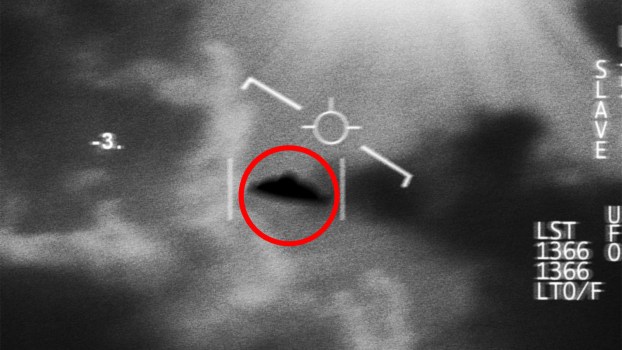
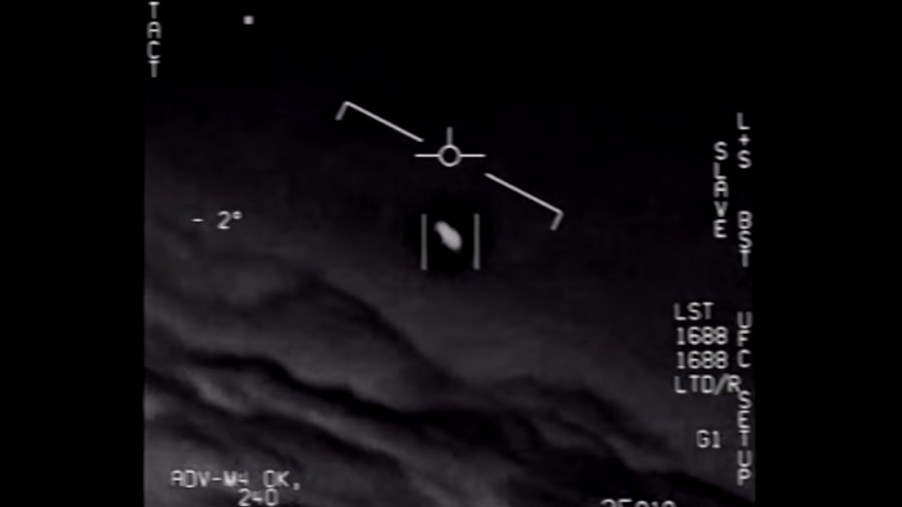
On November 14, 2004, six Navy F/A-18 Super Hornet fighter jets and an E-2C Hawkeye plane launched off the USS Nimitz approximately 100 miles off the coast of San Diego. According to the pilots, the aircraft was roughly 46 feet long and shaped like a Tic-Tac. Navy personnel observed the UFO on radar falling from 28,000 feet to 50 feet above the Pacific Ocean in just 0.78 seconds as they got close to the unidentified aircraft.
Another Navy veteran who was aboard the USS Princeton, a Ticonderoga-class guided-missile cruiser, stated that the UFO did not produce any sonic booms while traveling at an incredible 24,000 miles per hour.
Former Navy pilot who encountered the ‘Tic-Tac’ UFO speaks out
This week, Dietrich spoke to CBS News about the encounter and what the American public should expect from the government files once the government releases them.
“We had four folks who saw it visually, and it was tracked on multiple sensors, by other witnesses in that encounter,” she recalled. “And we saw something that we couldn’t identify in 2004 – something that appeared to violate what we understood about physics and aerodynamics in that moment. We reported it through our chain of command.
“So I’m not in the business of sensationalizing it, but I am in the business of being accurate,” Dietrich added. What does that mean for us right now? I think that transparency is the right instinct. What I hope that people understand is that releasing files is a process and not a revelation.
“It took over a decade for our ‘Tic-Tac’ video to become public. And what gets released, what gets declassified, and what those documents actually say are all very different questions. So, I would encourage people to be patient and to keep their expectations managed.”
“And I would also say, you know, folks get carried away when we use the term aliens,” Dietrich continued. “And I think that it’s important to reframe here and say instead of, ‘Are there aliens?’ to say ‘What’s operating in our restricted airspace that we can’t identify?’ and whether it’s adversarial technology, an unknown atmospheric phenomenon, or something else entirely. This is genuinely a national security and flight safety issue. So that’s the question that should drive this disclosure effort.
She wants to normalize speaking out for other pilots who encounter UFOs
Lt. Cmdr. Dietrich was then asked, “When you say the thing you observed and the others observed, the four of you defied what you understood about the laws of physics, what exactly do you mean?”
“So, we spend a lot of time practicing our maneuvers, using our time practice in the cockpit to really understand the way that our aircraft are moving and how to optimize that in order to get an advantage,” she replied. “We want to get a shot off. We want to make sure that we’re defending ourselves against adversaries in those encounters.”
“And so we practice, we calibrate our eyeballs in order to be able to recognize those moments,” she explained. “And when we encountered this strange thing on November 14th, 2004, it defied the laws of physics. We weren’t sure what we were looking at or how it was doing what it was doing. And I’ve tried over the years to normalize this for other aviators.
“For a long time, pilots didn’t report, and so that stigma has real consequences. And so I want people if they see something to be able to say something.”