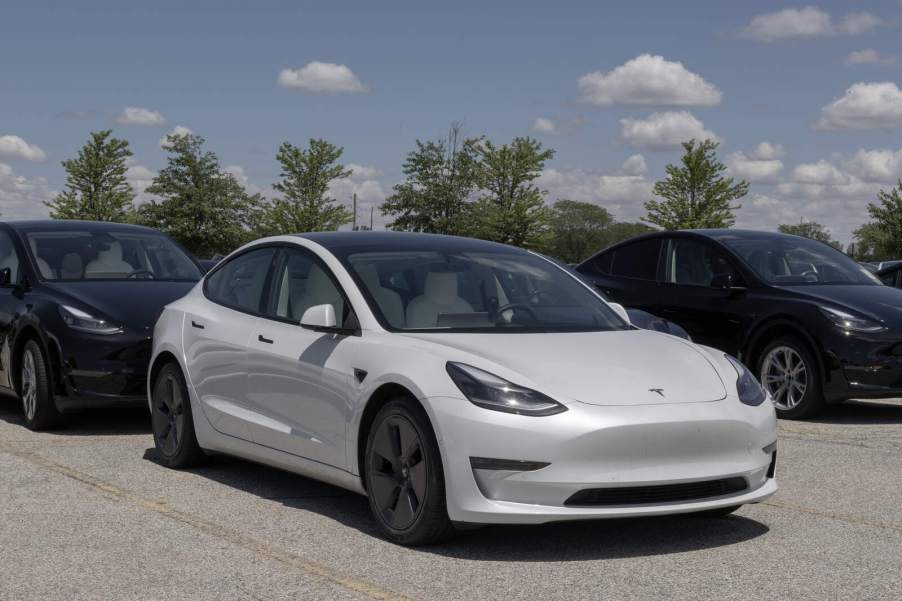
Parents are breaking windows to get their kids out of Tesla Model Y EVs
One of the less glamorous realities of Tesla ownership is that sometimes, the most basic function (like getting in and out) can turn into a high-stakes ordeal. That’s now under the microscope after the federal government confirmed multiple reports of parents smashing windows to free their children from Tesla Model Y crossovers.
The National Highway Traffic Safety Administration (NHTSA) opened a preliminary evaluation last week into more than 174,000 2021 Tesla Model Y vehicles
The authority’s Office of Defects Investigation received nine complaints about door handles failing.
Investigators said the problem occurs when the 12-volt low-voltage battery in the vehicle drops too low. This cuts power to the electronic exterior handles. Without power, the car can’t be opened from the outside.
Parents reported that the failures often happened during routine moments. For example, stepping away to help a child out of the rear seat. Or, perhaps, loading a child into the car and closing the door before walking to the driver’s side.
In four specific cases, parents resorted to smashing a window to regain access
While Tesla vehicles do include manual releases inside the cabin, children may not be able to find or operate them. The NHTSA noted this creates a serious entrapment risk in emergencies, particularly in heat or fire.
Indeed, MotorBiscuit already reported on specific cases of children trapped inside Tesla EVs. There was the grandmother in Scottsdale, Arizona, who called authorities after strapping her 20-month-old granddaughter in her Model Y’s back seat. When she walked around the vehicle, she was mortified to find the doors totally dead. Firefighters arrived and broke the window.
Another Tesla owner in Los Angeles found herself in a waking nightmare on a 109-degree day. She’d just finished charging the EV when she realized the vehicle had locked her outside. Her 13-month-old baby was inside. It took 8 minutes to smash the window. A Good Samaritan at the charging station helped break the glass.
None of the reports linked to the new investigation involved injury or death. But the issue highlights a recurring concern with Tesla’s design philosophy
Drivers often rely on software and electric power for functions that other automakers still backstop with mechanical redundancy.
Owners told NHTSA they didn’t receive any warning about low battery voltage before their handles became unusable, leaving them unprepared.
Adult Tesla drivers also get trapped
In 2019, a Florida man died in his Tesla Model S after a crash and subsequent fire. Bystanders were unable to open the electronic doors quickly enough.
And in August of last year, a man named Michael Sheehan died inside his Tesla Cybertruck. Reportedly, he was unable to escape after crashing. His family filed a lawsuit claiming the EV entered thermal runaway and the door locks lost power, trapping Sheehan in the burning vehicle.
Even outside of emergencies, some occupants report being stuck inside a Tesla after power failures, sometimes needing help from the outside to get out. Often, drivers and passengers alike seem unfamiliar with manual door operation. These stories reinforce the stakes of NHTSA’s probe.
According to Tesla’s owner’s manual, there is a procedure to restore power to the electronic locks by applying 12-volt current from an external source to points accessible from the front of the vehicle
But NHTSA observed that this process is complex, not widely understood, and impractical in a real emergency when seconds count.
The investigation, formally labeled PE25010, will examine the scope of the issue, Tesla’s power supply design for the door system, and whether the risk warrants a recall
At this stage, regulators are focused on the inability to open doors from outside the vehicle, though they will continue monitoring reports of entrapment from inside as well.
The NHTSA is already investigating Tesla over preventable car accidents that happen while drivers engage “Full Self-Driving” mode.