Lockheed Martin Unveils Autonomous Undersea Drone That Can Can Launch Aerial Drones and Fire Torpedoes
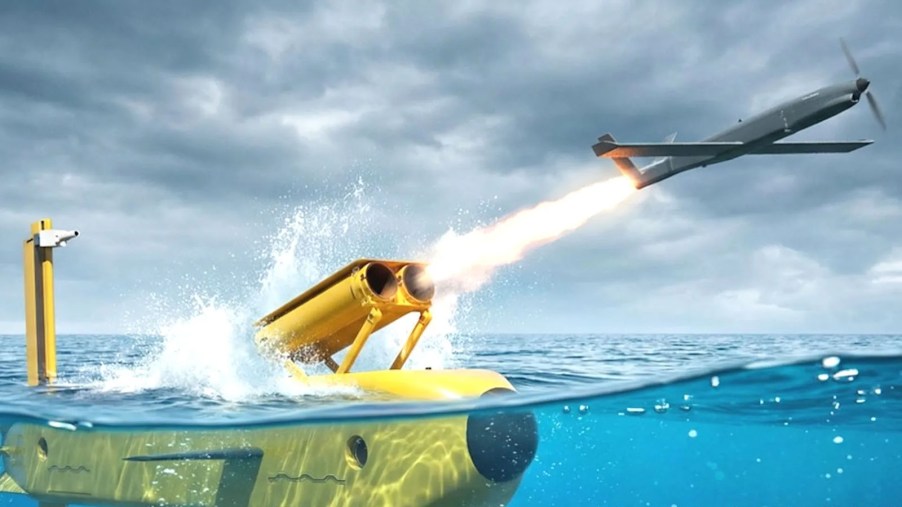
As if drones filling the sky these days aren’t enough to worry about, Lockheed Martin has revealed a new autonomous submersible drone. The new Lamprey Multi‑Mission Autonomous Undersea Vehicle (MMAUV) can launch aerial drones and fire torpedoes.
Lockheed Martin describes the Lamprey MMAUV as “a breakthrough ‘plug-and‑play’ submersible.” The Lamprey MMAUV gives U.S. and allied armed forces “a technological and strategic advantage in today’s contested maritime arena,” according to the defense contractor.
This might explain all of those underwater UFO reports that have been made public in recent years. Oh, and all of those underwater alien bases, too.
Capabilities of the Lamprey Multi‑Mission Autonomous Undersea Vehicle
According to Lockheed Martin, the LampreyMMAUV can arrive in the battle theater with a fully charged battery. It does that by “hitching a ride” on a ship or submarine. Then, it utilizes hydrogenators to charge its batteries.
The drones can then perform a wide range of missions. They include delivering undersea and air kinetic and non-kinetic effects; performing intelligence, surveillance, reconnaissance, targeting, and multi-intelligence collection; and deploying equipment to the seafloor. The Lamrey can also just lie in wait on the seabed, search for enemy naval activity, and attack or attempt to deny the enemy’s ability to move.
“The modern battlespace demands platforms that hide, adapt, and dominate,” said Paul Lemmo, vice president and general manager of Sensors, Effectors & Mission Systems at Lockheed Martin.
It has a 24-cubic-foot payload bay that can carry torpedoes, decoys, sensors, or unmanned aerial vehicles (UAVs). Lockheed Martin did not disclose the Lamprey’s range or speed.
What are experts saying about the Lamprey MMAUV?
According to Joseph Trevithick of The War Zone, groups of these drones could offer a “new, cost-effective way to establish distributed, highly disruptive networks to monitor naval movements across vast areas.”
They could also “offer an immediate way to attack enemy forces.” The military can seed them into highly strategic areas. This could provide additional sea control and area denial.
Sujita Sinha of Interesting Engineering writes, “As navies race to expand their underwater presence, autonomous systems are becoming central to maritime strategy. The oceans are vast, and crewed submarines are expensive to operate and maintain. Uncrewed undersea vehicles promise persistent surveillance, distributed sensing, and new options for deterrence and combat.
“However, endurance and power management remain major technical hurdles. Lamprey is the answer to that problem, combining autonomy with an unusual approach to energy use and deployment.”