Police hope you don’t know the “K9 unit” loophole used to search your car illegally
Imagine getting pulled over for a broken taillight. The cop checks your license, hands you a ticket, and starts to leave. Then he stops, turns back, and says, “Mind if I bring my dog around your car?” Suddenly, a routine stop turns into a drug search—no warrant required. Police often exploit this K9 unit loophole to skirt your Fourth Amendment rights. Here’s how it works—and what you can do to protect yourself.
When a traffic stop becomes a K9 unit drug search
It started as a routine traffic stop. Just after midnight, Officer Morgan Struble pulled over Dennys Rodriguez for briefly swerving onto the shoulder of a Nebraska highway. Struble checked licenses, ran records, and issued a warning ticket. By all accounts, the stop should have ended there.
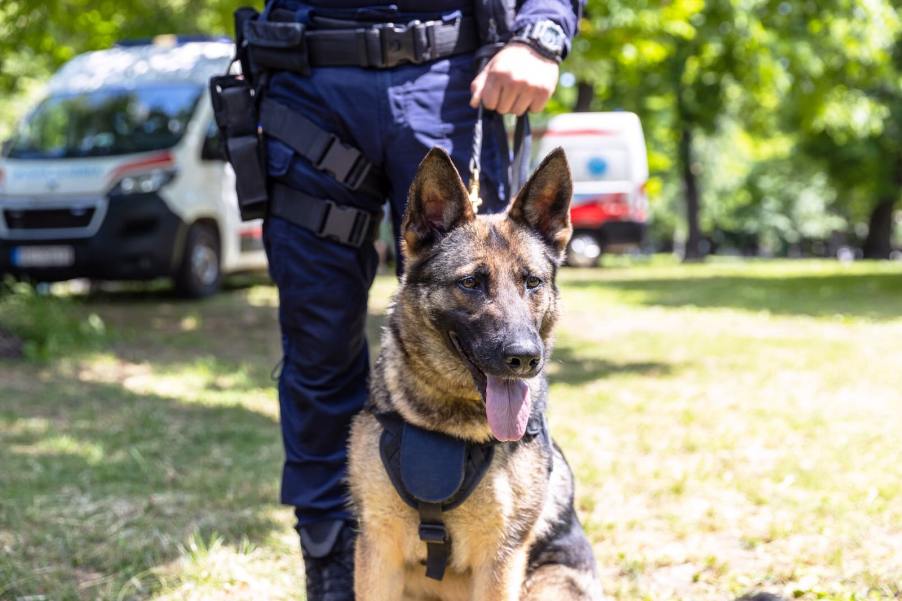
Instead, Struble asked Rodriguez if he could bring his K9 unit, Floyd, around the car. His wording highlighted the K9 unit loophole. He knew he could walk his dog around the car without a warrant. That meant he didn’t need reasonable suspicion Rodriguez had committed any crime. And if the dog “alerted” he had reasonable suspicion to begin a search. The only problem was getting Rodriguez to stick around.
Rodriguez said “No” to the K9 unit. But Struble detained him anyway, waiting for backup to arrive before retrieving his dog. Seven or eight minutes passed between issuing the ticket and the dog’s alert for drugs. The critical legal question is whether Struble could continue to detain Rodriguez for swerving onto the shoulder, after issuing a ticket.
Rodriguez challenged the search in court, arguing the delay violated his Fourth Amendment rights. The lower courts sided with the officer, calling the extra time a “de minimis intrusion”—too minor to matter. But the U.S. Supreme Court disagreed.
The Supreme Court’s ruling
In Rodriguez v. United States, the Court ruled that extending a traffic stop for a K9 unit dog sniff—without reasonable suspicion—violates the Constitution.
“A police stop exceeding the time needed to handle the matter for which the stop was made violates the Constitution’s shield against unreasonable seizures,” wrote Justice Ginsburg in the majority opinion.
The Court emphasized that traffic stops are meant to address traffic violations, not to investigate unrelated crimes. Ginsburg wrote: “A seizure justified only by a police-observed traffic violation… becomes unlawful if it is prolonged beyond the time reasonably required to complete th[e] mission of issuing a ticket.”
The ruling made it clear: once an officer finishes the reason for the stop, they can’t detain you longer without specific, reasonable suspicion of another crime.
K9 unit dog alerts aren’t always reliable
The ruling also highlighted concerns about the reliability of K9 unit searches. A Chicago Tribune investigation found that drug-sniffing dogs got it wrong more than 56% of the time. When the driver was Latino, accuracy dropped to 27%, raising concerns about racial profiling.
Despite these errors, courts often treat dog alerts as strong evidence, allowing searches based on little more than a canine’s reaction.
As the Supreme Court noted, “A dog sniff is not fairly characterized as part of the officer’s traffic mission.” That means waiting for a K9 to arrive—or conducting the sniff without cause—violates your rights.
Know your rights and speak up
The next time an officer steps away from your car and then circles back, don’t just sit there. Ask, “Am I free to go?” If they say no, you can ask why. Police need reasonable suspicion to extend your stop—even for a dog sniff. Don’t let a casual question or extra minute cost you your rights—or your freedom.