Hyundai/Kia is dumping its electric scooter startup
The shifting relationships between legacy automakers and electric vehicle startups are starting to feel like a game of musical chairs. For example: General Motors and Ford both courted Rivian before Volkswagen committed to a $5.8 billion joint venture with the US-based EV startup. Meanwhile, GM dumped a sizable investments in Lordstown. And then did the same thing with Cruise. Ford went the other direction: cutting back its huge Detroit EV team while betting heavily on its startup-sized “Skunkworks” department in California. So is it a shock that Hyundai Motor Group just dumped its $80 million worth of shares in an Indian startup called OLA? Honestly, kind of.
The Hyundai and Kia brands–as we know them–are both subdivisions of the larger Hyundai Motor Group. But they act with much more autonomy than, say, Chevrolet and GMC. Together, the two companies report they sank the equivalent of $300 million USD into an Indian startup called Ola Electric in 2019. Hyundai ended up with 2.47% of the company and Kia got less than 1%.
Other early investors included Tata and Softbank. By July 2019, the company claimed a $1 billion valuation. But it’s lost money for years. Ola IPOed in August 2024. Despite some initial investor confidence, share prices have continued to slump. They’re now down 46% since the IPO. So on the nose, it makes sense that Hyundai and Kia would cut their losses, selling out to the tune of $80 million. That’s 100% of Hyundai Motors’ stake and an undisclosed portion of Kia’s stake. But when you break down the numbers, it’s an odd move.
Is OLA Electric running out of juice or just getting started?
One reason OLA’s been losing money is its quest for acquisitions. It bought up Amsterdam-based scooter manufacturer Etergo, and Israel-based EV battery and charger builder StoreDot. It now owns tech that could help Hyundai Motor Group’s EVs worldwide. In addition, Ola built a scooter factory, a battery factory, and a huge R&D department. But OLA’s IP and facilities are a fraction of its value.
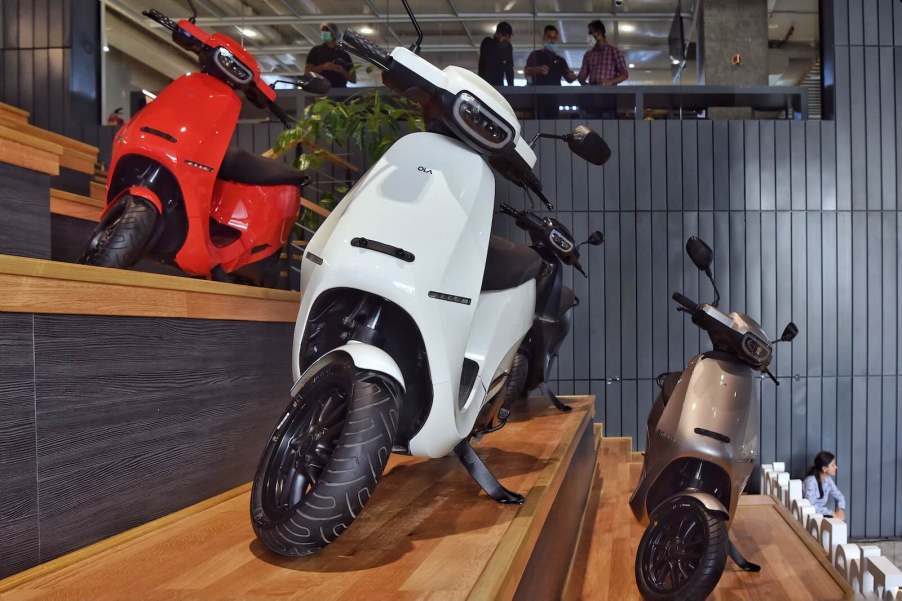
Here’s the real prize: OLA has carved out a place as the #1 electric scooter brand in India. I can’t begin to tell you how valuable that position is. This makes OLA the largest manufacturer of two-wheeled EVs outside of China. The company is in a unique position to dominate scooter sales in Asia and beyond. And that vehicle segment is one of the largest on the planet.
The Asian scooter market is worth $31.95 billion annually. That’s not motorcycles ore cars (both of which OLA is developing). That’s not Africa or South America, which are also huge scooter markets. That’s just scooters on one continent. Right now, most are gas-powered. But as electric scooters prove the cheapest form of transportation, they’ll gain momentum rapidly.
With OLA’s brand recognition growing, but its share prices slumping, now seems like a perfect time for Hyundai Motor Group to double down. It could develop a partnership, offer manufacturing and material sourcing help. And it could even rebadge OLA scooters as Kias as an upmarket option. But instead, it’s getting out of the game.
So the music is starting up again, and Hyundai is continuing to dance around the room. When the music stops, who knows which EV startup the South Korean automaker will find itself partnered with.