Here’s the Actual Difference Between Horsepower and Torque
When automakers hawk EVs, they often wave around big horsepower numbers. That’s partly because people equate high horsepower with speed and “wow” factor. But this unit of measure has a backstory, a precise definition, and real limitations. Diesel engines may not win the horsepower race, but they dominate where it might truly count: torque. Let’s unpack how these pieces fit together.
The race isn’t what you think
Imagine two runners: one sprints fast across 100 meters, the other hauls a weighted sled uphill. You might call the sprinter “powerful,” but the sled-hauler is doing work you can’t ignore.
In engines, horsepower is analogous to the sprinter’s speed, while torque is the raw hauling force.
In today’s market, EVs dominate headlines by touting high horsepower (often thousands of “hp”). Buyers see those numbers and expect performance. But horsepower is just one dimension.
Diesel engines can’t typically beat EVs or high-revving gas engines in raw horsepower. Yet diesels shine elsewhere, thanks to torque. Before that contrast, let’s dig into its origin and meaning.
Horsepower was originally a marketing move with real roots
According to ThoughtCo, James Watt popularized “horsepower” in the late 1700s to help mine owners and other industrial clients grasp how many horses an engine would replace.
He observed mill horses turning a wheel and estimated forces. He worked out that a strong horse could lift 33,000 foot-pounds in one minute (moving a 33,000-lb load one foot in a minute).
From that, he defined one horsepower. Over time, that unit stuck. Today, one mechanical horsepower equals 746 watts.
But there’s a bit of irony folded into this math: Watt’s estimate overshot what a typical horse could sustain. In effect, he gave his steam engines an advantage in marketing.
So horsepower began as a way to translate unfamiliar engine capability into a familiar baseline: horses. But the term evolved to mean the rate at which work is done, not the force itself.
What horsepower actually is as a mathematical formula
Power measures how fast work is performed. In engine terms:
Horsepower (hp) = (Torque × RPM) ÷ 5,252
And if that’s not mathy enough, this formula only works when torque is in pound-feet and rotational speed is in revolutions per minute.
That constant (5,252) aligns inches, feet, pounds, and minutes into the horsepower unit.
In practice, an engine’s horsepower curve peaks where the product of torque × rpm is greatest. That means a lot depends on how torque behaves across the rev range.
In the EV world, high horsepower numbers aren’t just for show. Electric motors can produce full torque at zero rpm, and maintain high torque over a broad band. That flexibility lets them deliver impressive horsepower even from low speed.
Why diesel engines fall behind in horsepower
Diesel engines run at lower RPMs compared to gasoline or electric motors. After all, they’re built for strong, slow pulling rather than high-revving bursts. Because horsepower is tied to RPM, lower rev limits translate into lower peak horsepower numbers for many diesels.
Also, diesels often have heavier internals and thicker components to manage high compression, which limits their redline ceiling. Even if a diesel produces strong torque, it can’t always spin fast enough to have a horsepower figure that rivals a high-revving gas or electric motor.
And anyway, diesel engines tend to optimize for durability, efficiency, and torque rather than screaming high rpm horsepower. So in the horsepower metric, they may appear less impressive. Which, really, is partly a measurement artifact, not a full reflection of capability.
Torque is the twisting force that makes things move
Torque is the rotational force an engine applies to its output shaft (the crankshaft). It’s measured in pound-feet (lb-ft) or Newton-meters (Nm). When you press the gas, torque is what tries to twist the drivetrain.
Getting down into how exactly it’s generated, torque in an engine is literally born from combustion pressure pushing on metal parts. It’s the twisting force created when explosions inside the cylinders push down on pistons, which then rotate the crankshaft.
Torque is the raw grunt force. Horsepower is how fast that force can be applied over time. In other words: torque is capability, horsepower is speed.
Engines that make high torque at low revs feel strong from a stop. That’s why diesels are beloved in trucks, heavy equipment, and towing. They can haul or pull without needing to rev hard.
Electric motors have a further advantage: they can deliver nearly full torque instantly from zero rpm. That gives them electric’s signature “instant shove” off the line.
What counts as “good” torque depends on purpose
| Make + Model | Approx. peak torque | What that feels like |
| Toyota RAV4 (2025 gas/hybrid variants) | ~ 163 lb-ft (≈ 221 Nm) from the 2.5-L engines in hybrid RAV4 models | This is enough torque for everyday driving (merging, passing, light towing). Not going to toss you back in the seat, but sufficient for what the RAV4 is designed to do |
| Tesla Model Y | ~ 430-670 Nm (which is ~ 317-494 lb-ft) depending on trim | Very strong torque especially off the line. EVs like this deliver full torque immediately, so the power feels very responsive from stoplights. Even base/long-range trims are noticeably quicker than many gas SUVs in low-speed pull |
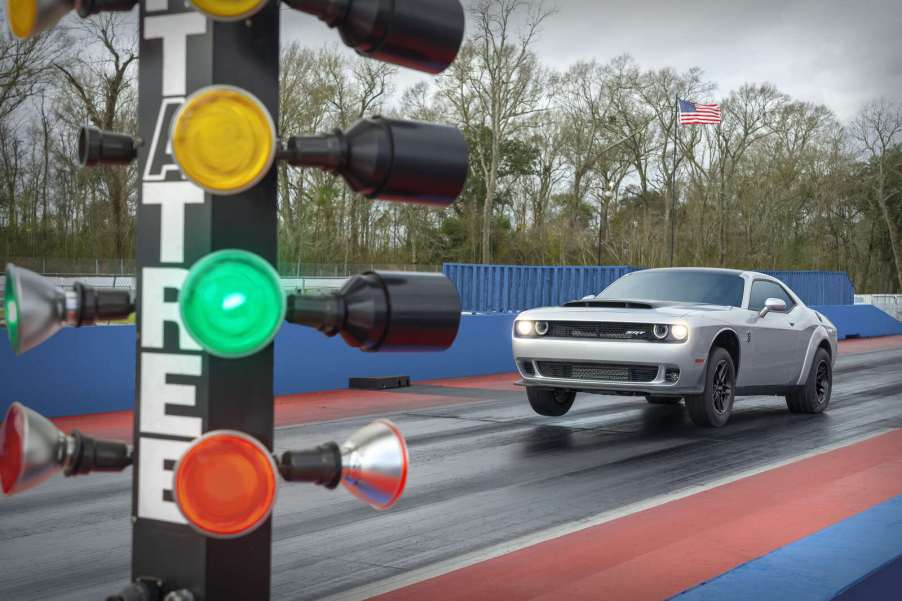
| Dodge Challenger SRT Demon 170 | ~ 945 lb-ft on E85 fuel (≈ 1,281 Nm) | That’s extreme torque. This is in the realm of serious drag/race performance. It feels like being shot out of a cannon; also requires beefy drivetrain components just to handle the twisting forces |
| Ford F-150 (recent powertrain options) | Several variants: 3.5L EcoBoost V6 ≈ 500 lb-ft, 3.5L hybrid variant ~ 570 lb-ft, larger V8s slightly less or more depending on trim | High torque like this is what gives trucks their towing, hauling, and low-speed grunt capability. It matters when pulling trailers, climbing grades, or carrying heavy loads |
When horsepower matters (and when it doesn’t)
Acceleration and responsiveness: Torque dominates here. The more twisting force available at lower rpms, the better the engine moves you out of a hole or up a grade.
Top speed and sustained performance: Horsepower is key when pushing that force at high revs over time. It’s what maintains speed once you’re up to pace.
Towing and hauling: Torque is king. You want strong, usable twist, especially in the low to mid rpm range. Diesel engines win here.
Everyday driving: A balance matters. Engines that spread torque broadly let you accelerate without hunting for revs; horsepower ensures you can keep pace or overtake when needed.
Comparing engines solely by horsepower is fairly misleading
Torque tells you how forcefully the engine acts. Horsepower tells you how fast it can sustain that action. When you understand both (and how they interplay), you see through the numbers and into what a car actually does on the road.