Google’s Self-Driving Taxis Getting Aggro, Gunning for East Coast
San Francisco residents warn that Google’s self-driving taxis have been reprogrammed. They’re navigating traffic like “an aggressive, New York taxi driver.” The timing is perfect—or terrible—because the company is eyeing an expansion to Philadelphia.
Laws that Waymo taxis are now breaking
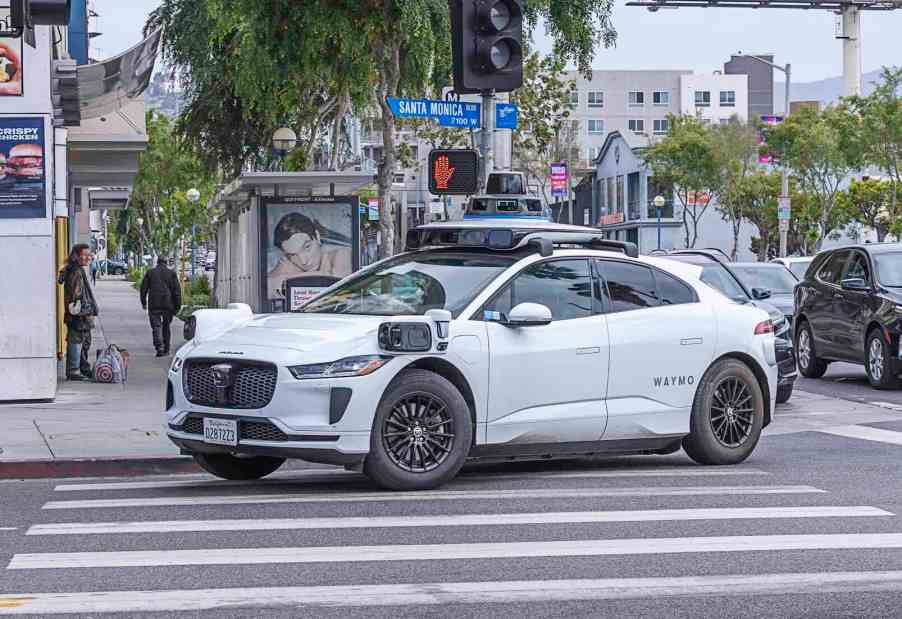
Legally, drivers must wait for an entire crosswalk to clear before moving through it. Responsible human drivers avoid hitting pedestrians, obviously, but many still roll through if pedestrians are far away. Now, Waymos act the same way. Marc Schreiber told The Wall Street Journal he “was taken off guard” when a Waymo accelerated through a crosswalk the moment his body was out of its way. “My next thought was, oh they’ve changed the programming to be more aggressive.”
Pacific Heights accountant Cossette Drossler says she’s heard reports of Waymos rolling through stop signs when no other cars are present at a four-way intersection.
San Bruno police recently pulled one over for an illegal U-turn. They approached the car, then realized it was a self-driving Waymo. With no driver to ticket, the surprised officers filed a “notice” with Google.
The NHTSA opened an investigation into Waymo taxis that allegedly sped around stopped school buses with flashing red lights and extended stop signs. In Austin, schools reported 19 violations. Google says it can fix the issue with a software update.
Why Waymo changed its driving style
Chris Ludwick, senior director of product management at Waymo, says the old, overly polite programming disrupted traffic in San Francisco. That call for reprogramming led to what the company calls its “confidently assertive” personality. “That was really necessary for us to actually scale this up in San Francisco, especially because of how busy it gets,” he said.
Passengers now report more aggressive behavior: zigzagging through traffic, sharper acceleration and braking, and closer distances to objects.
“They will go around a car or get closer to a car than a human driver would,” said passenger Jennifer Jeffries. “Sometimes I’ll be in the back seat and I’ll be like, ‘Ooh that was really close.’”
Waymo stresses that its cars still have 91% fewer crashes involving serious injury than human drivers. The tech keeps improving too. The fleet has logged 100 million driverless miles across San Francisco, Los Angeles, Austin, Phoenix and Atlanta. The company just announced it’s considering Philadelphia, meaning those “confidently assertive” taxis might soon meet actual New York cabbies.
The self-driving PR probem
My hot take: a self-driving car can thread the needle between obstacles more safely than a human. Doing so could speed up traffic for everyone. A fleet that communicates could smooth out stop-and-go jams. Waymos should be programmed to do these things. Passengers will eventually trust them to “get closer to a car than a human driver would.”
So what about rolling stop signs? Speeding through crosswalks? Zigzagging faster than the surrounding drivers can react? These are illegal. A New York cabbie wouldn’t think twice about them. But we shouldn’t program our worst habits into self-driving cars. The passenger would likely prefer a smooth ride over arriving 90 seconds earlier. Programming fleets to stay patient and polite might make our cities more pleasant.
The long and short of it is that self-driving cars have a major PR problem. Angry mobs have burned Waymos to the ground in both SF and LA. So for the time being, perhaps the taxis should be on their best behavior.