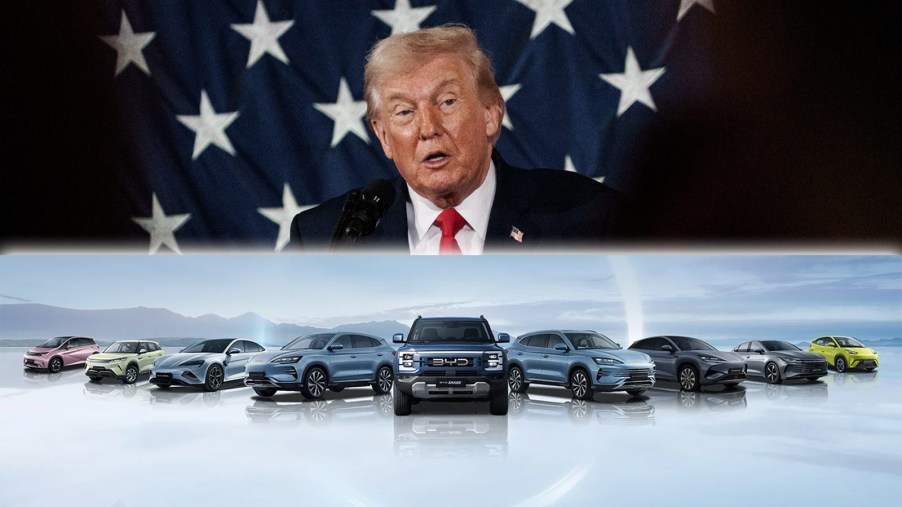
Companies Suing Trump to Recover $150 Billion in Tariffs Get Big Break With Supreme Court Ruling
The Supreme Court ruled on Friday that President Donald Trump overstepped his authority and invalidated his extensive tariffs on imports. The ruling could benefit several companies, including Chinese automaker BYD, who are suing the Trump administration to recoup at least $150 billion.
In a 6-to-3 decision, the Supreme Court majority found that the Constitution “very clearly” gives Congress the power to impose taxes, which include tariffs. However, Chief Justice John Roberts wrote, “The Framers did not vest any part of the taxing power in the Executive Branch.”
The invalidation of Trump’s tariffs could have a huge impact on the auto industry
Currently, several automakers and auto suppliers, including BYD, BorgWarner, Goodyear Tire & Rubber Co., Yokohama Tire, and multiple Toyota subsidiaries, have over $150 billion in lawsuits pending against the Trump Administration over tariffs. Recently, Toyota blamed the tariffs for a large portion of its $8 billion loss. Major tariff-related losses have also been reported by General Motors, Ford, Volvo, Subaru, and others.
Those are interesting takes by those companies, considering that according to a recent study, of the $200 million the United States made from President Donald Trump’s tariffs in 2025, 96% was paid by American buyers.
So what happens to all of the tariff money the US government has collected?
The Supreme Court did not say in its ruling what will happen to the more than $200 billion in tariffs the federal government has collected since the beginning of last year, according to the New York Times.
Justices Amy Coney Barrett, Neil Gorsuch, Sonia Sotomayor, Elena Kagan, and Ketanji Brown Jackson joined Roberts in striking down Trump’s tariffs.
“The president asserts the extraordinary power to unilaterally impose tariffs of unlimited amount, duration, and scope,” Justice Roberts added. “In light of the breadth, history, and constitutional context of that asserted authority, he must identify clear congressional authorization to exercise it.”
“We claim no special competence in matters of economics or foreign affairs,” Roberts wrote. “We claim only, as we must, the limited role assigned to us by Article III of the Constitution. Fulfilling that role, we hold that IEEPA does not authorize the president to impose tariffs.”
BYD claims in its lawsuit that Trump lacked the statutory authority to impose tariffs under the International Emergency Economic Powers Act (IEEPA), as “the text of IEEPA does not employ the word ‘tariff’ or any term of equivalent meaning.” Therefore, the court should declare all of the related tariff orders invalid.
It turns out that the U.S. Supreme Court agrees.