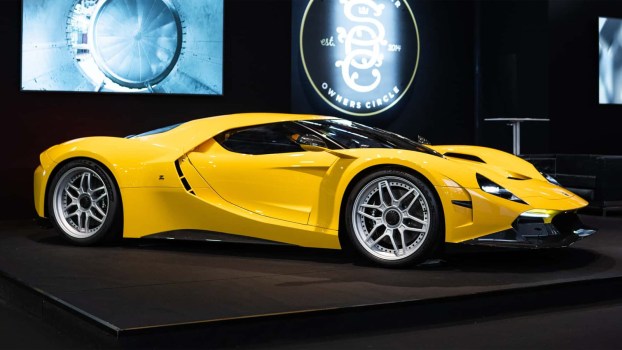
The latest prototype out of China could change the entire auto industry. By the numbers alone, it’s impossible to ignore: the weight of a Porsche Cayman, the track performance of a Ferrari GT race car, and the MSRP of a new Honda Accord. How? The Jiangling SC01 is electric.
- Configuration: Mid-mounted battery two-seater
- Powertrain: Front/rear electric motor AWD
- Curb weight: 3,000 pounds
- Output: 429 horsepower
- Performance: 2.9 second 0-60 (claimed)
- Range: 323 (targeted)
- Battery: 60 kWh lithium-ion
- MSRP: $30k (targeted)
At this point, it’s obvious that the future of performance is electric. Only the most expensive gasoline-powered supercars can compete with mid-level EVs’ acceleration numbers. But EVs could also be cheaper to build and maintain than ICE vehicles. So it’s only a matter of time before the default affordable performance car is an EV.
I believe the Jiangling SC01 would take the U.S. market by storm. I’d much rather see Detroit build a better version. But the U.S. would need to change how it thinks about EVs.
Currently, we’re just throwing larger battery packs into larger vehicles. This gets a higher range while maintaining a third row. But they are heavy and expensive. Electric motors make so much torque they can still beat a Porsche to 60 mph. But a small, lightweight EV sports car could actually corner, and be cheap. Sure, it’s not the right transportation solution for everyone. But it would be wildly popular. And like the Miata, it would be the sort of entry-level halo car that could put any brand on the map.
The Jiangling Motors SC01
One reason the SC01 is so darn cool may be that it was originally developed by a boutique tuner startup. The shop eventually sought out Jiangling Motors for one of China’s rare automaker permits. But not before getting this car right. These speed demons just get it.
This car has a battery pack that’s about 60 kWh. Depending on the technology used, that comes in at about 790 to 1,500 pounds. It’s likely the heaviest component of the 3,000-pound car. So the engineers actually stacked it just behind the rear seats as a “mid-mounted battery.” Yeah, just like a mid-engine car.
This is a brilliant solution. The “skateboard chassis” that’s become ubiquitous with EV design is great for huge battery packs. But this central battery means the handling dynamics are even better because the SC01 can go from a left-hand to right-hand turn faster (Google: lower polar moment of inertia).
The battery placement also means the SC01’s driver and passengers sit even lower. Finally, it allows for an absolutely huge trunk. That’s kind of nice to have in a sports car.
Think the central battery pack will translate to a higher center of gravity? Think again. The SC01’s center of gravity is less than 15 inches above the pavement (380 mm). That’s not sports-car low. Also, that’s not supercar low. No. That’s actual GT-class race car low. The result is, well, race car handling. Add in its purposefully tunable suspension and you have a cheap car that could rule the streets and tracks.
Honestly, the rest of the SC01’s numbers almost don’t matter. It’s aiming for a 323-mile range, which might be possible with its low drag coefficient and because you can switch off either the front or rear electric motor. That would be 323 miles / 60 kWh for a 5.38 miles/kWh burn. And that’s what the Lucid Air Pure does, so certainly possible. But the range doesn’t matter.
Why? With a battery pack that small, if they build this thing with 800-volt charging, you’ll be able to top up the battery in 10–15 minutes. A two-hour (150-mile) range would be fine for road trips. A three-hour (200-mile) range would be excessive. I hope there’s a version with half the battery and 400 pounds less weight. It would also be a bit cheaper.
How quick is the SC01 in a straight line?
Finally, horsepower. It’s a metric we love to brag about today. But trust me, in the electric performance era it’s going to matter very little. Each of the SC01’s two engines makes 215 ponies.
With a cool airplane-style toggle switch in the ceiling, you can swap from FWD to RWD to AWD. Switch both motors on and the SC01 can make a full 429 horsepower. That’s less than 7 pounds per horsepower.
By my calculations, its weight-to-power ratio is neck-and-neck with the 2021 Porsche 911 Turbo S and 2020 BMW M8 Competition. It beats the 2014 Nissan GT-R, C7 Corvette, supercharged 2014 Cadillac CTS-V, and 2001 Viper. It, of course, trounces the weight-to-power ratio of modern naturally aspirated V8 muscle cars. Cars in its price bracket—from the Toyota Supra to the Honda Civic Type R to the WRX STI—don’t even come close. The SC01 has half the weight-to-power ratio of a Miata. And with maximum torque at zero RPM, its acceleration will make almost every other car look like they’re sitting still.
The SC01 is very much a car engineered to corner. But Jiangling claims it can rocket to 62 mph in 2.9 seconds. That’s a hair slower than Ferrari’s top-of-the-line 12Cilindri, which experts predict might squeak by with a 2.7-second time. See the SC01 for yourself in the video embedded below: