Chevrolet got EVs right the first time, and has been chasing that high ever since
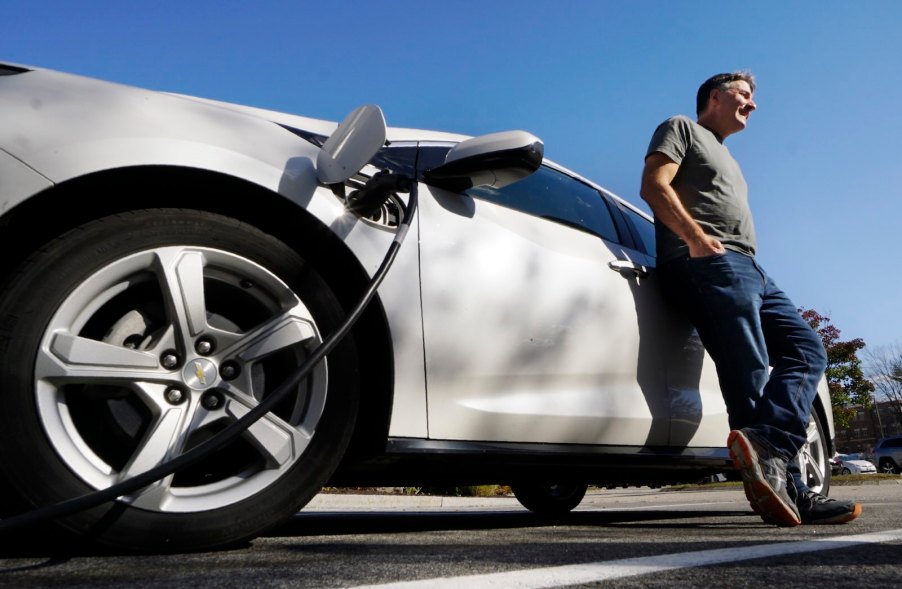
You’d be forgiven for mixing up Chevrolet’s old “Volt” and newer “Bolt” electric vehicles. The similar names may have seemed clever to the marketing team, but they’re so close they’re easy to confuse. The Bolt was a relatively standard compact Chevy made from 2017 to 2023. The Volt (2011 to 2019) is one of the only series PHEVs available and has developed a cult following on the used car market. This may be why Chevrolet is bringing the Volt back.
The Chevy Volt was a high point in PHEV design
Chevrolet’s Volt sedan was one of the only “series hybrids” sold in the United States. This means it had a traditional EV setup—an electric drive unit to spin the front wheels powered by a lithium-ion battery pack in the frame. But it also had an internal combustion engine that worked like a generator to recharge the battery on the fly. That meant if you wanted to take the Volt on a road trip, you could fill its gasoline tank and cruise down the highway as if it were a regular car.
Jay Leno bought a 2011 Chevrolet Volt. Despite a garage full of priceless classics and modern supercars, Leno used the Volt as his daily driver. He gushed about how great the little car was.
With its small battery pack, the Volt only offered 40 miles of electric range. But Leno admitted that with his commute (as host of The Tonight Show) and errands, he rarely drove more than 35 miles in a day. A year after buying his Volt, he had only used half of his 9.3-gallon gas tank.
Leno loved his Volt so much, it converted him to an electric car enthusiast. He ended up buying a series of Teslas for his daily drivers.
With the Bolt, Chevrolet missed a step
Chevrolet followed the beloved Volt with a more traditional EV. The Bolt was a four-door compact hatchback. It offered no internal combustion “range extender” engine option. Instead, it had smaller and larger battery pack options. The largest gave it up to 320 miles of range but made the car heavier and more expensive. With charging speeds limited to 240 volts, it took time to top it off during a road trip.
The Bolt sourced its large battery pack from LG Corporation. But quality control issues led to a series of high-profile battery fires. LG paid to replace every battery pack during a Bolt recall, and today used ones aren’t at risk of spontaneously combusting.
Though most automakers offered vehicles similar to the Bolt during the late 2010s and early 2020s, EVs have struggled to gain market share. Finally, Chevrolet canceled its poorly selling Bolt.
Since introducing the Bolt, Chevrolet has tried to go big with its EVs. It introduced the GMC Hummer EV, electric pickup trucks, and the Cadillac Celestiq. All have been celebrated for their design and features, but all have huge battery packs that drive up the cost, weight, and charging time. General Motors makes no EV truly suitable for a road trip.
More automakers are catching on that the series hybrid was a solution ahead of its time. Multiple range-extended EV models are in development. A small battery and gasoline-powered generator cost less and weigh less than a huge battery pack. It’s an excellent solution to range anxiety and real-world problems like long road trips. It makes perfect sense that Chevy—the pioneer of the range-extended hybrid—is bringing back the Volt.