The Cheapest Brand-New Cars You Can Buy Today Are, Surprisingly, SUVs
For years, the list of cheapest new cars was predictable. Models like the Kia Rio, Mitsubishi Mirage, and Nissan Versa were regular fixtures at the bottom of the sticker price charts.
They were tiny sedans, often bare-bones, but easy on the wallet. Walk into any dealer lot five years ago and that’s what you’d see if you asked for “the cheapest car.”
Well, those days are fading fast. Those cars were sunset in 2023, 2024, and 2025, respectively.
But it’s not actually a bad thing, in my mind.
Today, the cheapest new cars in the U.S. aren’t small sedans
They’re SUVs.
The shift reflects a broader trend in the market. Compact economy crossovers have taken the place of the traditional budget car.
Buyers still want value, but they also want space, a higher driving position, and more versatility.
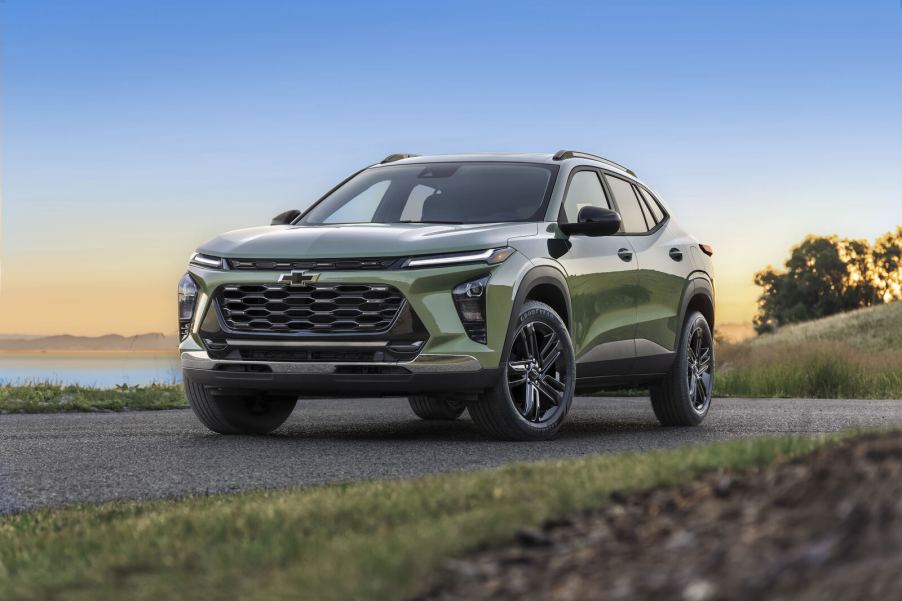
Automakers have responded, and few vehicles illustrate this shift better than the 2026 Chevy Trax and the 2026 Hyundai Venue.
The Chevy Trax and Hyundai Venue now sit at the top of America’s affordability chart
The Venue edges out the Trax with a starting price of about $22,150, while the Trax begins at $22,995 including destination fees.
Both aim for first-time buyers and anyone hunting for new-car reliability without a premium price tag. But they take different approaches.
The Hyundai Venue runs a 1.6L four-cylinder engine with 121 horsepower, paired with a continuously variable transmission and front-wheel drive.
It returns roughly 31 MPG combined and remains easy to maneuver, thanks to its compact footprint.
Inside, even the base model comes with an 8-inch touchscreen and wireless Apple CarPlay and Android Auto.
For 2026, Hyundai simplified its trim lineup and added more features like heated seats and wireless charging on higher trims.
Chevrolet’s answer, the Trax, uses a smaller but turbocharged 1.2L three-cylinder engine that produces 137 horsepower and 162 pound-feet of torque. That extra torque helps it feel livelier at city speeds, though both vehicles offer similar fuel economy.
The Trax stands out for its size. Despite the bitsy engine, it’s longer, wider, and provides about four more inches of rear legroom and over a third more cargo space than the Venue.
Tech-wise, the Trax matches or exceeds the Venue’s feature set, offering larger screens and advanced safety systems on even mid-level trims.
Stylistically, both crossovers deliver more polish than the budget cars they’ve replaced
The Venue has a friendly, upright look suited for city living, while the Trax leans toward a sportier, more planted stance.
Each appeals to slightly different drivers: the Venue to urban commuters and minimalists, the Trax to those who need a little more room or highway confidence.
The insiders at GM Authority lean toward the Trax (no big surprise) as the stronger long-term value, citing its interior space, turbocharged powertrain, and modern tech integration as key reasons.
I tend to agree. My brother-in-law’s car was stolen this year, and while police waited for it to show up across town, his insurance company gave him a Chevy Trax.
It was pretty slick. Sure, definitely an economy car, but its exterior look and interior feel were actually quite modern and roomy for the price.
But the bigger takeaway may be what both vehicles represent
The end of the cheap compact sedan era and the rise of the affordable SUV as America’s new entry point into car ownership.
For budget-conscious drivers who still want a new car, the Trax and Venue are shaping up to be the new benchmark for value in today’s SUV-driven market.