‘Stupid,’ Cardiologist-in-training tells Dave Ramsey he deserves a $250,000 Porsche loan ahead of starting the job
By the time you finish years of medical school and residency, rationality and self-restraint get a long, thorough workout. So when a newly minted cardiology fellow called into Dave Ramsey’s show asking whether he could responsibly obtain a Porsche with a sign-on bonus, the tension between a pricey participation trophy and financial sense played out in real time.
The caller, a cardiologist-in-training named Mo, laid out what he called a justified splurge: a five-figure signing bonus, steady rental income, and a household about to earn a mind-boggling annual salary. Sounds pretty dang optimistic on the earnings front.
But what followed was less an argument about taste and more a crash course in timing, leverage, and the hidden costs of wanting status on four wheels. Scroll down to watch the whole call.
Mo started the call with Dave Ramsey by framing his life as finally paying off
He explained that he and his wife had lived modestly through training. Mo had a signing bonus coming between $75,000 and $100,000. We’ll call it $75k to be conservative.
The cherry on top (or is the sundae itself?) arrives in the form of an incoming salary that would put the total household income at roughly $750,000 after just the first year.
Oh, and they already own two houses: A rental in Florida with about $150,000 left on the mortgage. After expenses, that home nets roughly $1,000 a month. Yeah, their primary home still has hundreds of thousands worth of mortgage remaining. But both properties tout equity at this point.
Mo says he’s got about $60,000 in emergency fund cash, plus has that fresh bonus (though the ink isn’t even dry). Now he wants a new toy.
The caller sure sounds wealthy, but he technically can’t afford the car he wants
See, the car he has in mind isn’t modest. Initially, he told Dave Ramsey that he wanted to spend the entire sign-on bonus on a Porsche.
Ramsey didn’t sound all that perturbed at first. “So, you want to buy a $75,000 car?”
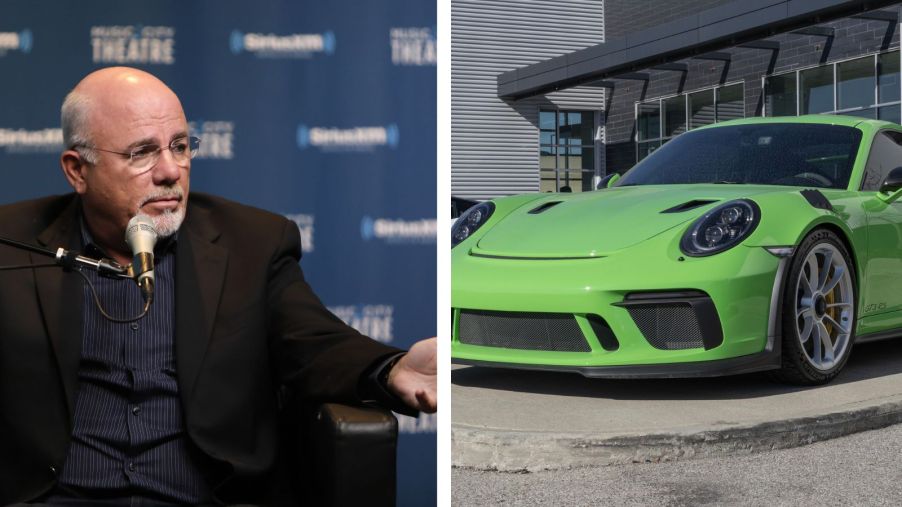
Well…no. It turns out that the $75k cash would just be the down payment. Mo has his heart set on a $250,000 Porsche.
Which Porsche costs $250,000?
In the call, a specific model isn’t exactly mentioned. Of course, “Porsche” covers a wide spread…from Carrera entry models to limited-run, track-focused beasts.
So a $250,000 price tag can mean different things depending on the model year, options, and rarity.
911 Turbo S (current gen): A top-trim, twin-turbo 911 with all-wheel drive; higher trims and extensive options can push a new Turbo S into the low-to-mid-six-figure range. It’s about raw, usable speed, all-weather capability and a high level of daily comfort.
911 GT3 RS/GT2 RS and earlier RS variants: Limited-run, track-focused 911s command serious premiums on the used market. A GT3 RS or a GT2 RS, especially with low miles and desirable options, can cross the $250,000 threshold.
Special editions and lightly used collector cars: Special editions, one-off packages, or lightly used performance models (including certain Turbo S Exclusive or Heritage models) often trade at steep marks above sticker.
High-end Taycan variants or Cayenne Turbo GT with full options: A fully optioned Taycan Turbo S or a top-spec Cayenne with performance packages can approach or exceed $200k. With factory add-ons they can edge toward $250k in some configurations or on the used market.
Generally, $200k-$250k gets you significantly more power, bespoke materials and options, and either more track capability or extra comfort and tech. It all depends on the model. You’ll hear Dave’s opinion on these aspects in a minute, by they way.
But technically speaking, the Turbo S variants prioritize explosive acceleration and all-weather usability. GT-badged cars prioritize weight savings, aerodynamic upgrades, and track performance. Collector or limited editions add exclusivity and often hold value better…though that’s not guaranteed.
Dave Ramsey’s response was equal parts blunt and pragmatic
Ramsey reminded Mo that he routinely tells callers not to take on car payments, then framed the choice as a test of priorities.
After all, Mo’s probably facing a hefty stack of student loans. There’s the two mortgages, too. And if the couple has or is planning on having kids, they’re certainly not free, either. All of a sudden, while $60,000 in savings and $1,000 in rental income sure seems a whole lot better off than most American households, it just isn’t life-saving in this case.
Might I also mention that taxes, repair, insurance, and depreciation all scale with a Porsche’s purchase price. So total ownership costs for an ultra-expensive Porsche hit hard after many buyers bring them home from the dealership.
Dave quickly told Mo that he wasn’t going to bless a brand-new car payment that would otherwise eat into a once-in-a-lifetime wealth-building opportunity.
“You’re three-to-five years early on this purchase.”
The personal finance pro said Mo could absolutely buy a $250,000 Porsche. Well, provided the family was debt-free, the emergency fund was fully stocked, and the car was bought in cash.
Until then, Dave Ramsey suggested a different plan: sell the Florida rental (calling the $1,000 monthly net a poor use of capital). Then use the signing bonus toward a sensible used Porsche bought for cash in the interim. Finally, wait a year or two to let income and savings shift the family’s long-term trajectory.
And anyway, in the host’s mind, Porsches are great, but a $75k model isn’t actually all too different than the $250k one. Don’t come at me on that, Porsche fandom…them’s Dave’s words, not mine. I do wonder, though, which owners out there really own way more Porsche than they actually need.
In any case, Ramsey framed the choice this way: with Mo’s incoming pay, one calendar year of discipline could clear the mortgage and put the family on a different course. No house payment, healthy college funds, and the option to buy that Porsche without the moral weight of a loan.
He repeatedly made the psychological point that after a decade of being responsible, the urge to splurge is understandable. But the whole impulsive, acting-on-it-early move can cost a lot more than a little immediate pleasure.
Car loan debt often traps drivers in unending payments
The heart of Dave Ramsey’s advice exposes the psychology of payments.
Auto loans translate a luxury good into a recurring obligation that compounds in three ways: interest, opportunity cost, and behavioral drift.
Interest is obvious. You ultimately pay the dealer and the lender more (a lot more) than the original MSRP.
Opportunity cost is often invisible: Every monthly payment that leaves a bank account could instead reduce a mortgage, seed a retirement account, or grow a college fund. In my household’s case, it went to eight years of daycare (grumble).
Behavioral drift is the quietest danger. Once you accept payments as normal, lifestyle inflation becomes contagious.
The luxury car payment that starts as a “reward” can become a baseline expense that inflates family budgets, reduces flexibility, and raises stress when life throws curveballs
Dave Ramsey suggests the caller just drive a $100,000 Porsche for a while. It seems silly to the rest of us, but the advice is shorthand for “buying down the risk.”
The concept translates to any car shopper. Buy something you love that doesn’t require financing, enjoy it, and then decide later whether an “ultra-expensive” increment is worth the tradeoffs.
In other words, debt converts wants into obligations. When wants stack up while you have a mortgage, children on the horizon, or student loan hangovers, the compounding cost of financing can lock families into decades of payments for items that only depreciate.
You deserve it. Just not right now
Mo earned the right to reward himself, sure. And yeah, maybe a $250,000 Porsche is a reasonable, attainable dream for someone on his trajectory.
But Dave Ramsey’s point was that timing matters more than permission. Pay off debt, sell underperforming assets, build liquid reserves and then buy the thing with cash. That way, the car is a celebration, not a chain.
If Mo follows that plan, he gets the Porsche and the pride without the long-term drag of a payment. He also gets the better prize, in my mind: financial freedom that multiplies the reward, making one expensive car feel like a small, guilt-free punctuation in a life that’s otherwise set up to thrive.