Mechanic Removes Tire. Then He Reveals How To Take One Off In The Upper Midwest
In a funny Facebook video, Doug Sampognaro, a mechanic in Illinois, jokingly shows the difference between Rust Belt mechanics and mechanics who aren’t in the Rust Belt.
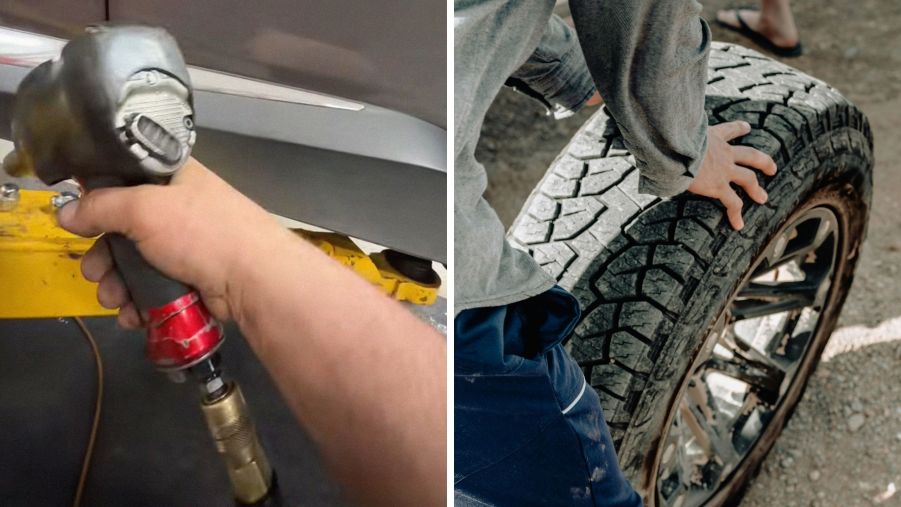
Initially, he shows himself using an impact wrench and easily taking a wheel off a car. Then, as the Rust Belt mechanic, he swings on the axle of the suspended car as he tries to dislodge a stuck wheel.
What is Sampognaro suggesting here? What’s going on in the Rust Belt for mechanics?
We can glean some clues from the comments.
The Peanut Gallery
“Come in for new tires, leave with new A Arms, struts, [and] wheel bearings,” said one person.
“And the very same mechanic won’t anti-seize the hub when he puts it back on,” joked one commenter.
Sampognaro replied, “I don’t do that, and you possibly might have the wheel falling off, cause it won’t perfectly lay flush when tightening. I always clean [them], then and grease them, not with [anti-seize] tho cuz you should know that [anti-seize] will get rock hard. I’m a purple grease guy.”
What are these guys talking about?
You Want Lube Or Grease?
Anti-seize lubricant, as the commenter mentioned, is a protective, high-temperature compound, usually copper, aluminum, or nickel-based, that mechanics use to prevent metal parts from seizing, galling, and corroding under extreme pressure or heat. It makes taking off threaded fasteners, spark plugs, and exhaust components easier by creating a protective barrier.
The problem is that it’s pretty thick if misapplied, and could create a spacer between the wheel and hub. Sampognaro’s position — that it causes a tough build-up that creates a major issue if the wheel cannot be put back on flush — is spot-on.
When Sampognaro says he uses “purple grease,” what he’s likely talking about is the popular Permatex Extreme Ceramic brake lube. It is designed for metal-to-metal contact surfaces, such as brake components. More to the point here, it’s thinner and more pliable than anti-seize. It will keep the seating flush, without gumming up or drying out.
But Why the Rust Belt?
It’s the weather.
Mechanics in the Rust Belt, or the greater Salt Belt in this case, aren’t just working with dirty cars; they are in an eternal battle with chemistry.
In most winters in states like Michigan, Ohio, and Pennsylvania, transportation departments use millions of tons of road salt to keep highways passable. But, that same salt corrodes the metal beneath every vehicle out on the road.
When salty moisture comes into contact with the tight joints between an aluminum wheel and a steel hub, it causes galvanic corrosion. This is a process where two dissimilar metals react electrochemically, forming a bond similar to glue.
When rust expands, it can occupy more volume than the original steel and push the wheel away from the hub. Once it breaks loose, it relieves the lug-nut tension, creating a safety hazard. The key here is that whenever aluminum and steel come into contact with salt, rust is inevitable.
In Sampognaro’s case, or for other tire techs’, the corrosion can result in the steel wheel hub effectively being welded to the aluminum steering knuckle. What happens is, you get a wheel that should slide smoothly off with an impact wrench becoming something you have to use your full bodyweight to crack loose.
MotorBiscuit reached out to Sampognaro via Facebook message and comment.