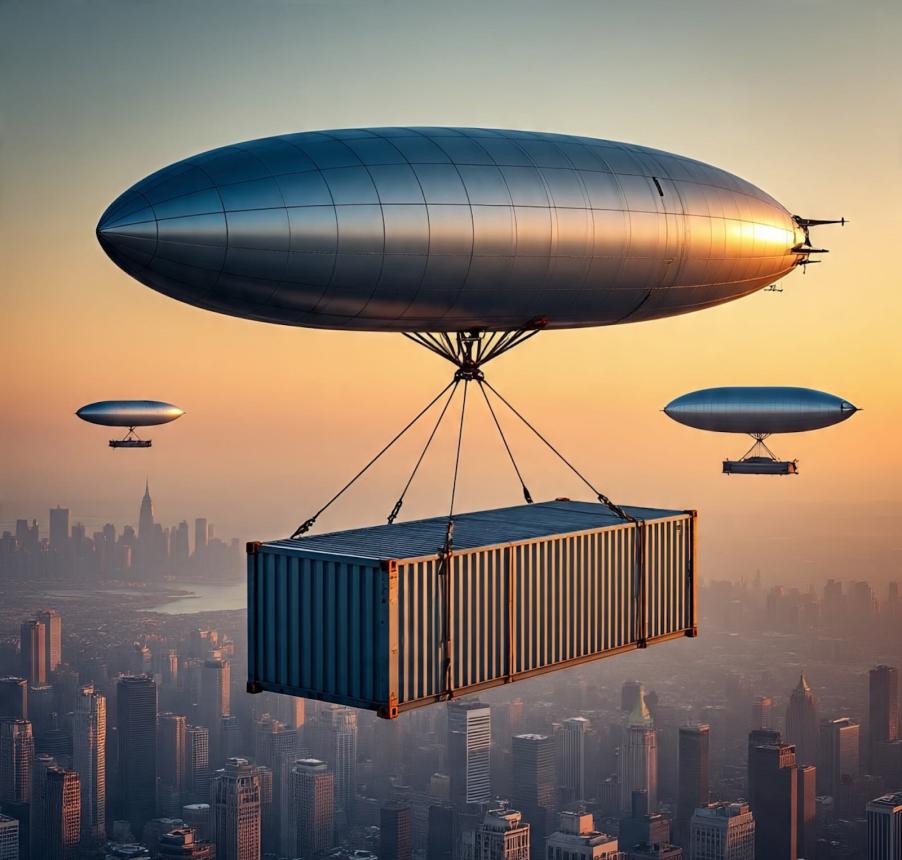
Airships may soon be the ‘trucks of the sky’
Imagine a world with highways free of long-haul semi trucks. Instead, convoys of blimps float silently overhead. And when you do have to ship something the size of a car—or larger—you don’t have to worry about the nearest loading dock. Or even the nearest road. You just punch in GPS coordinates for pickup and delivery, and your freight gets hoisted into the sky. This is the future some experts say is closer than you think.
Most folks consider airships a relic of a past era. It’s as if lighter-than-air travel crashed and burned with the Hindenburg. But the science YouTube channel Veritasium explains, “Right now, a handful of companies around the world are competing to build a new generation of airships.” Why? There’s a race to debut the “trucks of the sky.”
If you think about shipping in the U.S., trucking isn’t the fastest way to get anything from point A to B. That requires putting it on an airplane. Trucking also isn’t the cheapest way from point A to B. That’s either a freight train or, in some places, a container ship. So why is trucking so popular? “The combination of speed and price puts them in this sweet spot of cheap enough and fast enough, which is why they transport the vast majority of goods.”
The economy grows more internationally entwined every year. So what is the intercontinental version of “trucking?” Boats are cheap. Planes are fast. But so far, we don’t have a shipping option that can cross oceans while hitting that fast/cheap sweet spot. But our modern jets have a major weakness: they use 30-40% more fuel getting to elevation than cruising. And they must cruise three times faster than any truck just to stay airborne. That’s why many investors are betting big on airships.
Airship definitions: the difference between a zeppelin and a blimp
A zeppelin is an airship with a rigid structure. This allows it to be much larger than a blimp. It can also compress individual cells of its lighter-than-air gas to offset the weight of various cargo loads.
Airships don’t need runways, so they could decentralize shipping. This could be huge for rural industries and landlocked countries. Airships could be fully electric. They could even pick up lithium-ion cells along with other cargo, based on the range they’ll need for a given trip. They could drop them at power stations en route. And airships are slow enough that they could be automated or operated remotely. Think whale-sized delivery drones.
This new freight network could be big business. If airships “take over half of the ocean freight container market at a price comparable to trucks, say 10 cents per ton kilometer, that would equal $650 billion of revenue per year. And if that was all served by one company, it would be the biggest company in the world by revenue. Bigger than Apple or Amazon or Walmart.” No wonder everyone is eager to build a working freight airship.
A robust network of airship manufacturers and routes would also open the door for airship travel. With lower energy requirements, airships could offer a cheaper form of air travel. And while they will never travel as quickly as the fastest jets, they could make more stops like a bus and cut down total travel time.
A freight future that floats?
A planet crisscrossed by huge airships is an image fit for a cool retro-futuristic comic book. It’s an entirely possible future—but is it likely? Honestly, only time will tell. But using jetliners for freight is far from a sustainable future. Besides limiting where we can use and transport resources, and beating up runways and planes, it relies on finite fossil fuels.
Let’s hope whatever transportation solutions we adopt enable cheaper travel, cheaper shipping, and do a better job allowing us to spread out resource extraction and get cheap goods to people in more places on the planet. You can see the Veritasium video on airships embedded below: