What’s a respectable 0 to 60 mph time in 2025?
Enthusiasts and casual drivers alike love to talk about 0 to 60 times. Automakers splash them across spec sheets, YouTubers time them with GPS gear, and owners boast about them at the gas pump. After all, in 2025, the numbers can be dizzying. Some EVs get there in less than two seconds, while popular family cars take twice (or even three times) as long. So what’s actually considered “respectable” these days? The answer depends on what you drive, how you use it, and how much speed you really want at your disposal.
Defining “respectable” 0 to 60 times
A decent 0 to 60 time isn’t a single number.
For most everyday sedans, SUVs, and pickups, anything in the five- to six-second bracket feels quick. It’s fast enough to make highway merges stress-free and backroad passing effortless, without dipping into the high-cost, high-maintenance territory of serious performance cars.
Slip into the four-second zone, and you’re talking enthusiast-level acceleration where launches feel as aggressive as they sound.
Anything under three seconds is in the exotic EV or hypercar class: blisteringly quick, but far beyond what’s necessary in daily traffic.
If you grew up in the 1990s or early 2000s, you’ll know that “quick” meant something very different than it does today
Back then, a mid-six-second 0 to 60 mph time put you firmly in performance territory.
The fourth-gen Toyota Supra Turbo and Mazda RX-7 could both break into the low-five-second range, and that was headline-worthy.
A BMW M3 from the E46 era, one of the most respected sports sedans of its day (I think so, anyway, we have a 2004 325i), clocked in around 4.8 to 5.1 seconds depending on the test.
Family cars were far slower
The mid-90s Toyota Camry V6 needed roughly 8 seconds to hit 60, while Honda’s Accord V6 of the early 2000s wasn’t much faster.
SUVs and trucks were even more leisurely. A Ford Explorer of the late 90s might take over 10 seconds to reach 60, and full-size pickups often pushed 11 or 12. Nobody complained much because those times were simply the norm.
Even performance icons we now think of as lightning-quick would struggle to match the numbers from today’s base-model EV crossovers. A 2000 Chevrolet Corvette C5 could get to 60 in just under 5 seconds, but now you can match that in a family-friendly Tesla Model Y Long Range or a Hyundai Ioniq 5 N…cars with space for five, big cargo areas, and no gasoline at all.
It’s a reminder of how far engineering has come
In just two decades, the kind of acceleration that once required a tuned sports car or muscle coupe is now available in an everyday commuter, a midsize SUV, or even a hybrid pickup.
That shift is why the definition of “respectable” keeps changing. What was once blistering is now just average.
Let’s look at what some of the best-selling cars in the country can do
To put that in real-world context, take the 2025 Toyota Camry, one of the most popular sedans in the U.S.
In XSE AWD trim, it can do 0 to 60 in about 6.8 seconds, while a front-wheel-drive XLE runs closer to 7.1.
In the compact SUV category, the 2025 Honda CR-V Hybrid Sport Touring takes around 7.9 seconds, and the non-hybrid EX-L comes in at roughly 8.1.
Trucks, though, have made huge gains. The 2025 Ford F-150 with the PowerBoost hybrid system reaches 60 in a surprisingly quick 5.0 seconds. That’s faster than some so-called sports sedans from the early 2000s.
Everyday performance in 2025
For many drivers, a car in the five- to six-second range feels perfect.
It’s enough punch to keep you ahead of traffic without requiring expensive tires, premium fuel, or heavy maintenance costs.
The 2025 Ford Mustang EcoBoost falls neatly into this category at about 5.6 seconds, as does the Volkswagen GTI at around 5.9. Both prove you don’t need a big V8 or dual-motor EV to feel genuinely quick.
Speaking of EV acceleration: They’ve changed the game
Electric vehicles have redrawn the performance map. Instant torque from electric motors means even mainstream EVs often post numbers that used to belong to sports cars.
The 2025 Tesla Model Y Long Range hits 60 in about 4.4 seconds, while the Model Y Performance drops that to roughly 3.5.
The Hyundai Ioniq 5 N comes in at around 3.3 seconds, giving hot hatch acceleration in a roomy crossover body.
Ford’s Mustang Mach-E GT Performance Edition is in the same low-three-second range, showing that family EV crossovers can rival traditional sports cars off the line.
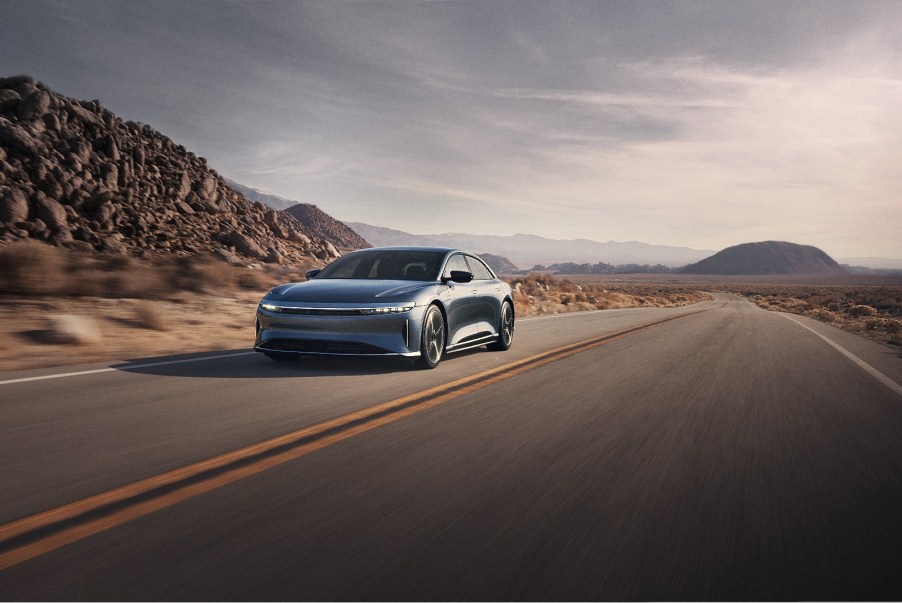
And then there’s the Lucid Air Sapphire, an ultra-luxury EV sedan capable of under two seconds…territory once reserved for million-dollar hypercars.
Stepping into enthusiast territory
If you want sharper thrills, 2025 offers plenty in the three- to four-second window.
The BMW M2 automatic clocks in at about 3.9 seconds, delivering an old-school rear-wheel-drive feel with modern speed.
The Porsche 911 Carrera GTS gets there in roughly 3.1 seconds, a reminder that Porsche still knows how to blend precision engineering with everyday usability.
How hybrids Fit into the 0 to 60 conversation
A decade ago, hybrids were better known for stretching fuel than sprinting. That’s changed.
Modern hybrid and plug-in hybrid powertrains often deliver quicker launches than their gas-only counterparts, thanks to instant electric torque.
The Toyota Camry Hybrid reaches 60 in the mid-seven-second range, which matches or beats some older V6 sedans.
Plug-in SUVs like the 2025 Toyota RAV4 Prime and Hyundai Tucson PHEV dip into the mid-five-second bracket, making them quicker than many non-performance crossovers.
Even full-size trucks benefit. Ford’s F-150 PowerBoost hybrid (5.3 seconds) and Toyota’s Tundra i-Force Max (5.7 seconds) both show that electrified setups aren’t just about towing and efficiency.
These days, a respectable 0 to 60 mph time is all about context
For a commuter sedan or family SUV, five to six seconds is quick enough to feel confident without overkill. If you’re after excitement, three to four seconds delivers thrills while staying manageable for everyday use. Anything under three is a conversation starter…and maybe a ticket magnet. The key is matching the car’s capability to your lifestyle.