The OG 1964 Ford Mustang was a lackluster bargain car
In the early 1960s, Ford exec Lee Iacocca had a brilliant idea. Make style and performance accessible to every driver by mass-producing a small, V8-powered “pony car.” The result was the 1965 Mustang (released in early 1964). And it was so wildly popular, it changed the car market forever. Before, you signaled taste with a huge Lincoln or Cadillac. After, you could hold your head high while driving a small sports car. But as first-generation Mustangs become sought-after classics, it’s easy to forget that the OG pony car was a true bargain.
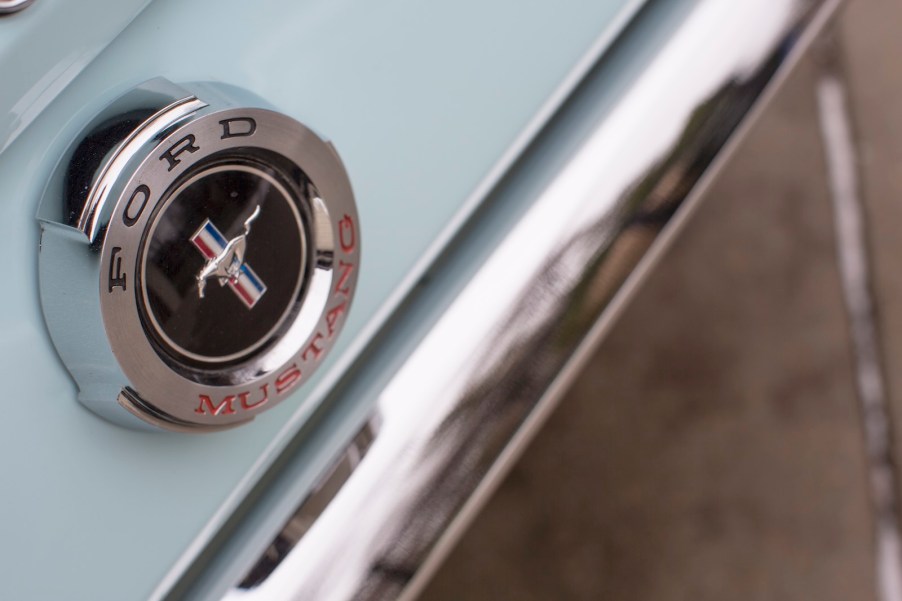
Ford debuted the Mustang at the 1964 World’s Fair. The car was cool. The car was available with a V8 and four-speed manual. And the eye-catching new car had an MSRP you couldn’t ignore: $2,368.
Adjusted for inflation, that’s the equivalent of $24,428 in 2025. If Ford dropped the Mustang today, it would still be impossible to ignore. Ford advertises a $31,920 MSRP for its 2025 EcoBoost Mustang. A Toyota GR86 or Mazda Miata will set you back $30k. But would a base 1964 Ford Mustang keep up with modern standards? Could the OG Mustang even keep up with the cheapest car of 2025, the Nissan Versa S ($18,330)?
Would a base 1964 1/2 Ford Mustang keep up with modern standards?
A base 1964 1/2 Ford Mustang, with its small I6 engine, couldn’t keep up with the cheapest car you can buy in 2025. If you bought a base 1965 Mustang today, you’d definitely be cruising in the right lane on the highway.
Ford labels its first Mustang a “1965” model. But because the automaker began building them halfway through 1964, collectors call the early ones 1964 1/2. So what did you get for your $2,368? The base engine was Ford’s 170 cubic-inch inline six-cylinder (that’s 2.79 liters). Car and Driver reviewers called the base engine “a piece of machinery about as exciting as a dish of baby food.” It made 101 horsepower (at 4,400 rpm) and 156 lb-ft of torque (at 2,400 rpm).
Cool visualization of Mustang prices every year since 1964 (adjusted for inflation).
byu/OpulentOwl inAutos
The base transmission was a three-speed manual that cut costs by skipping the synchros in first gear. A hardtop weighed in around 2,600 pounds. Your time to 60 mph was at least 13 seconds. That would put your new Mustang a bit ahead of some farm trucks on the road in 1964.
Compare the 1964 Mustang with the 2025 Nissan Versa. The modern compact boasts a 1.6-liter I4 and stick shift. It makes 122 horsepower. It also weighs in just under 2,600 pounds. You can probably slap your way to 60 mph in 10 seconds if you’re keen to go. In addition, that Nissan Versa offers you two more gears than your base 64 1/2 ‘Stang. So it can keep up with modern highway traffic, if you don’t mind shifting often. Your I6 Mustang would be sticking to the right lane on a modern highway.
Even the cheapest cars on the road today feature a higher top speed than the budget models from the 1960s. They have airbags, reverse cameras, and almost all vehicles have electric windows and automatic emergency braking. The fact that you can still get a car for under $25K is a testament to how much automakers have cut production costs. That said, many 1960s Mustangs are still around. And they are one of the best choices for a muscle car project you can buy. I doubt we’ll be saying the same about a Nissan Versa in 60 years. Check out Hagerty’s first-gen Mustang buyers guide in the video embedded below: