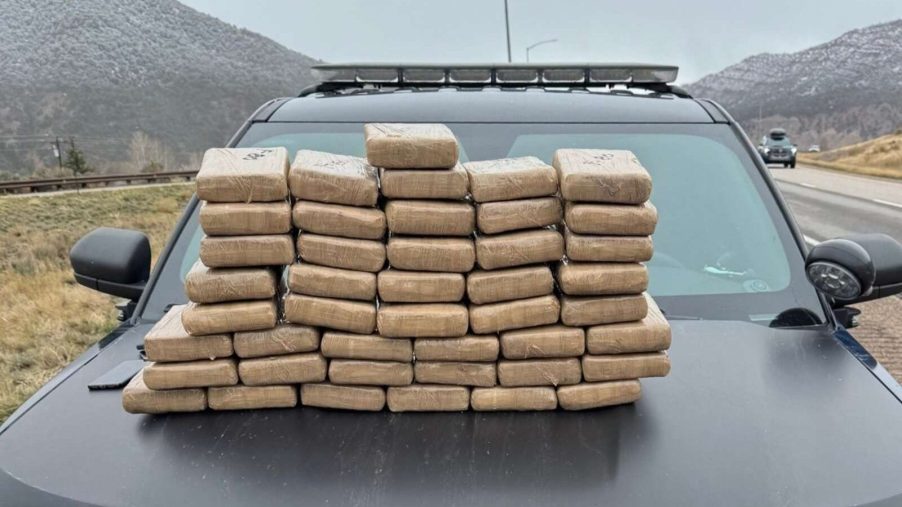
Colorado police pull over a driver for leaving his lane in Eagle County, find 111 pounds of cocaine
Deputies in Eagle County, Colorado, pulled over a driver last Tuesday morning on I-70, just past mile marker 140. The stop happened around 10 a.m. after police spotted the car drifting out of its lane. The man behind the wheel, 34-year-old Scott Robinson from Ontario, Canada, didn’t exactly help his case during the traffic stop.
According to the Eagle County Sheriff’s Office, Robinson said a few things that didn’t sit right with deputies.
Suspicious, police called in a K-9 unit
The dog sniffed around and signaled possible drugs in the vehicle. That gave the narcotics team a green light to take a look inside.
What they found: 44 packages of cocaine – individually wrapped and stacked up to a total of 111 pounds. Not exactly subtle.
Police arrested Robinson on the spot and booked him with charges including unlawful distribution of a controlled substance and conspiracy. KOLN shared that a judge set his bond at $1 million, and he’s currently sitting in an Eagle County jail cell.
Now, let’s talk fallout.
In the U.S., getting caught with this much cocaine doesn’t end in a slap on the wrist
Under federal law, trafficking significant quantities of controlled substances like cocaine carries severe penalties. For a first offense involving 5 kilograms (approximately 11 pounds) or more of cocaine, the mandatory minimum sentence is 10 years in prison.
Given that police found Robinson with 111 pounds (approximately 50 kilograms) of cocaine, this amount far exceeds the 5-kilogram threshold. Therefore, he would be subject to the mandatory minimum sentence, up to life in prison.
It’s also important to note that prior convictions can significantly increase penalties. For instance, a second offense involving such quantities can lead to sentences ranging from 20 years to life.
And because Robinson’s Canadian, immigration law also kicks in
A felony drug conviction usually leads to deportation after serving time. So even if he makes it through the U.S. court system, Canada may still have something to say. Under Canadian law, importing or trafficking cocaine ranks as a serious criminal offense, and authorities up north could decide to investigate further.
Right now, police haven’t released where Robinson came from or where he planned to go. But with that much cocaine in one car, chances are high he’s not the only person involved.