We’ve all had that dangerous thought at 2:00 AM while scrolling through Facebook Marketplace. What if I just buy this absolute piece of junk, bolt a massive turbo to it, and see what happens?
Most of us eventually go to sleep and forget about it. The guys at the YouTube channel Crucible Coachworks actually did it.
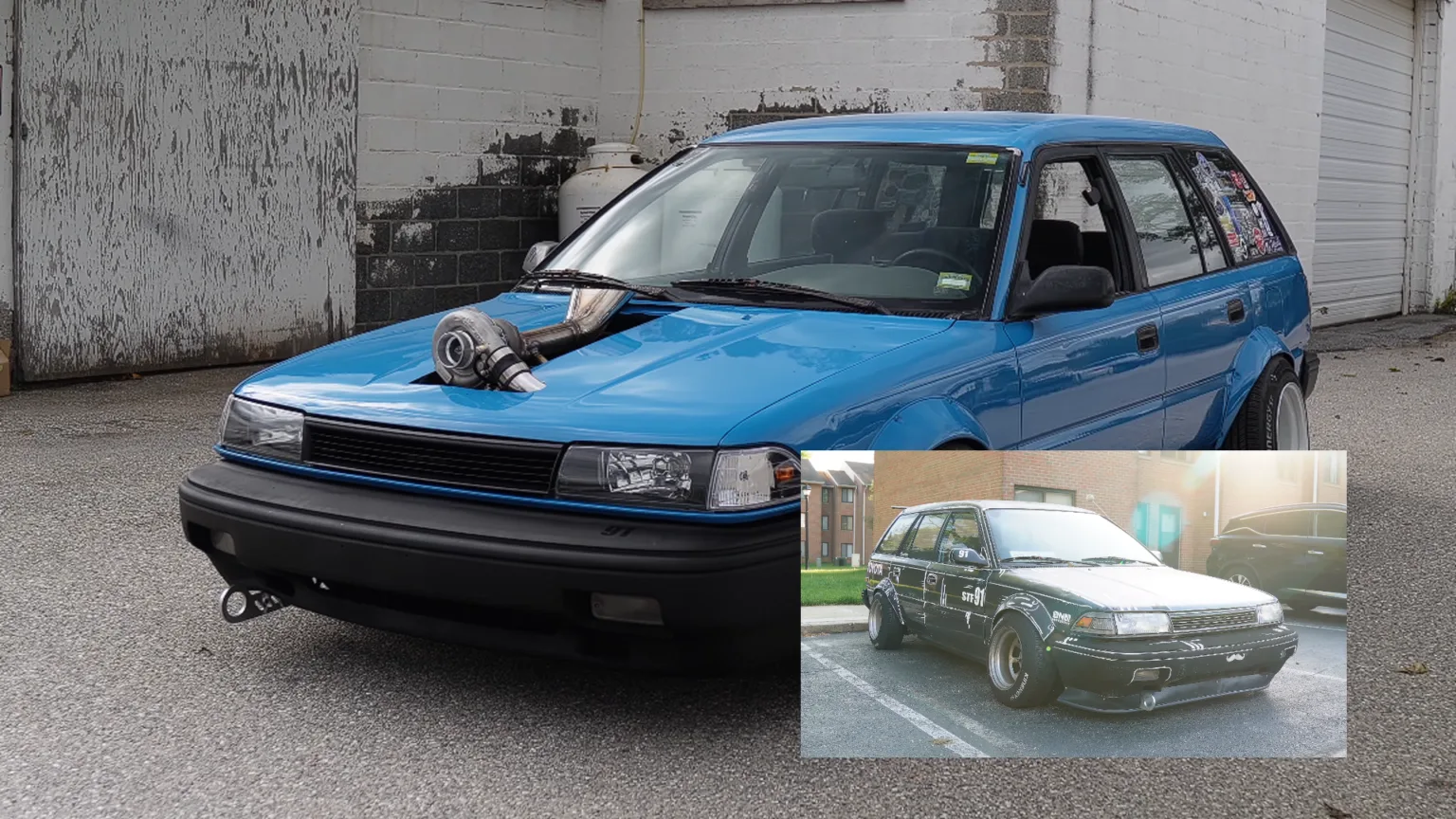
To celebrate hitting 100,000 subscribers, hosts Ryan and Tony decided to build the ultimate budget project car. No expensive standalone ECUs, no pre-fabricated turbo kits, and no high-dollar safety nets. Just pure, unadulterated “16-year-old in a garage” energy applied to a 1991 Toyota Corolla manual wagon they picked up for 800 bucks.

“Most importantly, our goal is to see if you can build a budget car as if it was your first project car in 2025,” Ryan explained. “We’re going to use our ingenuity and what’s available to us at a low cost to see if we can turbo this car, paint it, and have a fun car when it’s done.”
The “Pod Racer” Exhaust
When you’re turbocharging a car that already has 280,000 miles on the odometer, logic usually dictates that you should probably take it easy. Instead, the crew was gifted a massive turbo from MaxPeedingRods that was “like half the size of the engine”.

Because the turbo was physically too large to tuck cleanly into the engine bay, they decided to just mount it directly in the center, chop a massive hole in the hood, and point the exhaust straight up into the air.
“I really think instead of us like mounting this thing and putting it somewhere up in the top over here… why don’t we center this bad boy and construct the hood around it to make this almost like a turbine,” Ryan suggested, pitching a Star Wars-inspired design. “It needs to look like a pod racer when we’re done.”

The result? A hilariously aggressive hood-exit exhaust that looked like a jet engine and violently spat flames (and occasionally oil) directly onto the windshield.
Tuning Without a Tuner
Bolting a giant turbo to an exhaust manifold is the easy part. The real nightmare of budget boosting is getting the fuel mixture right so the engine doesn’t instantly detonate into a million pieces of hot shrapnel.
Because the 1991 Corolla uses a MAP (Manifold Absolute Pressure) sensor rather than a Mass Air Flow sensor, the crew couldn’t use a cheap piggyback tuner like a Super AFC to add fuel under boost. They had to get creative.

“To add extra fuel under boost, we couldn’t let the ECU do it. And so we’ve tied into the cold start injector, which will just spray raw fuel into the intake at our specified boost level,” Tony explained, basically force-feeding the engine raw fuel whenever the turbo spooled up.
When that wasn’t enough, they added a rising rate fuel pressure regulator and swapped in an even larger auxiliary injector. It was messy; it was completely old-school, but it actually worked. The tired old 1.6L engine managed to push up to 10 PSI of boost without immediately launching a rod into orbit.
The Ultimate Budget Survivor
By the end of the video, the $800 wagon had been fully transformed. It was wearing a fresh coat of Eastwood “Volvo Rebel Blue” single-stage paint (applied via paint roller and spray gun), riding on restored white wheels, and whistling with 10 PSI of turbocharged boost.
“I love this car. I’m probably going to daily drive it here and there just for fun,” Ryan admitted, completely ignoring the fact that it was essentially a ticking time bomb.

Crucible Coachworks set out to prove that you don’t need a $10,000 budget to have fun building a project car in 2025. Sometimes all you need is an $800 beater, a free turbo, a welder, and absolute disregard for your engine’s internal components.